Though it was one of the most advanced civilizations of its time and responsible for the most ancient prehistoric urban sites across the Indian subcontinent, the Indus Valley Civilization was forgotten for millennia, until 20th century archaeologists rediscovered and began excavations at Mohenjo-daro and Harappa. Although the civilization primarily flourished between approximately 3000 and 1500 B.C., these ancient Indians had longer lasting influences on the urbanization of the Indian subcontinent for centuries after, thanks to their monumental buildings and walls, enormous manmade platforms, innovative architectural techniques, and evidence that they engaged in trade over vast distances, with high-quality artifacts sent from the Indus Valley as far as Mesopotamia and even Africa.Of course, the Indus Valley Civilization and their successors, the Aryans, also influenced indigenous Indian religion and mythology. In the West, Hinduism is a religion that everyone has heard of but one that few non-practitioners truly understand. Today it is widely regarded as one of the world’s great religions and considered the indigenous religion of India, with practices and beliefs stretching back thousands of years.In reality, Hinduism as it is conceived of today is a conglomerate of a number of indigenous Indian religions. In fact, prior to the migration of Islam and the corporate invasion of the British, Hinduism may not have existed at all. Rather, a number of local religious traditions had very old belief systems dating back hundreds or thousands of years, depending on the tradition, and many worshiped gods that are no longer worshiped today. In essence, it was only through the non-indigenous populations in India, namely the Turks and later the British, who defined what Hinduism was. The British in particular asked only a certain subset of native informants from Bengal “what their religion was” and got a very particular answer, giving rise to the West’s perception of a singular religious Indian tradition known as Hinduism. If the British had not centered their investments in Calcutta, they may have asked a different group of Indians what their religion was and received a different answer, thus changing the popular conception of Hinduism altogether. Additionally, in the same way Christianity contains many smaller, spirituality heterodox groups like Gnostic Christianity (which are sometimes called cults), Hinduism also contains many groups that have beliefs that do not fit easily within the common corpus of Hindu belief systems. All of these divisions came well after the time of the Aryans, and Hinduism likely began to divide around the 1st century A.D., over 1,000 years after the arrival of the Aryans into the Indian subcontinent.In conjunction with the development of religions, including not just Hinduism but also Sikhism, Jainism, and Buddhism, the diverse traditions and ethnic groups that have called India home over the past 5,000 years combined to create a mythology that is as eclectic as it is interesting. Unraveling the details of India’s mythological systems is no easy task, but thankfully, hundreds of scholars who have studied Indian history have successfully translated thousands of ancient and medieval Indian texts into English and other modern Western languages. In the West, Buddhism is a religion that everyone has heard of but one that few truly understand aside from Buddhists themselves. For almost 2,500 years, Buddhism has been dominant on the Indian subcontinent, based on the traditions, beliefs, and practices that came about from the teachings of the Buddha (Siddhartha Gautama), the Sansrkit word for “the awakened one.” Today, it’s believed that upwards of half a billion people practice Buddhism today, and some of the traditional practices and principles of the religion, including the concepts of karma, reincarnation and the practice of yoga.
save
$5.99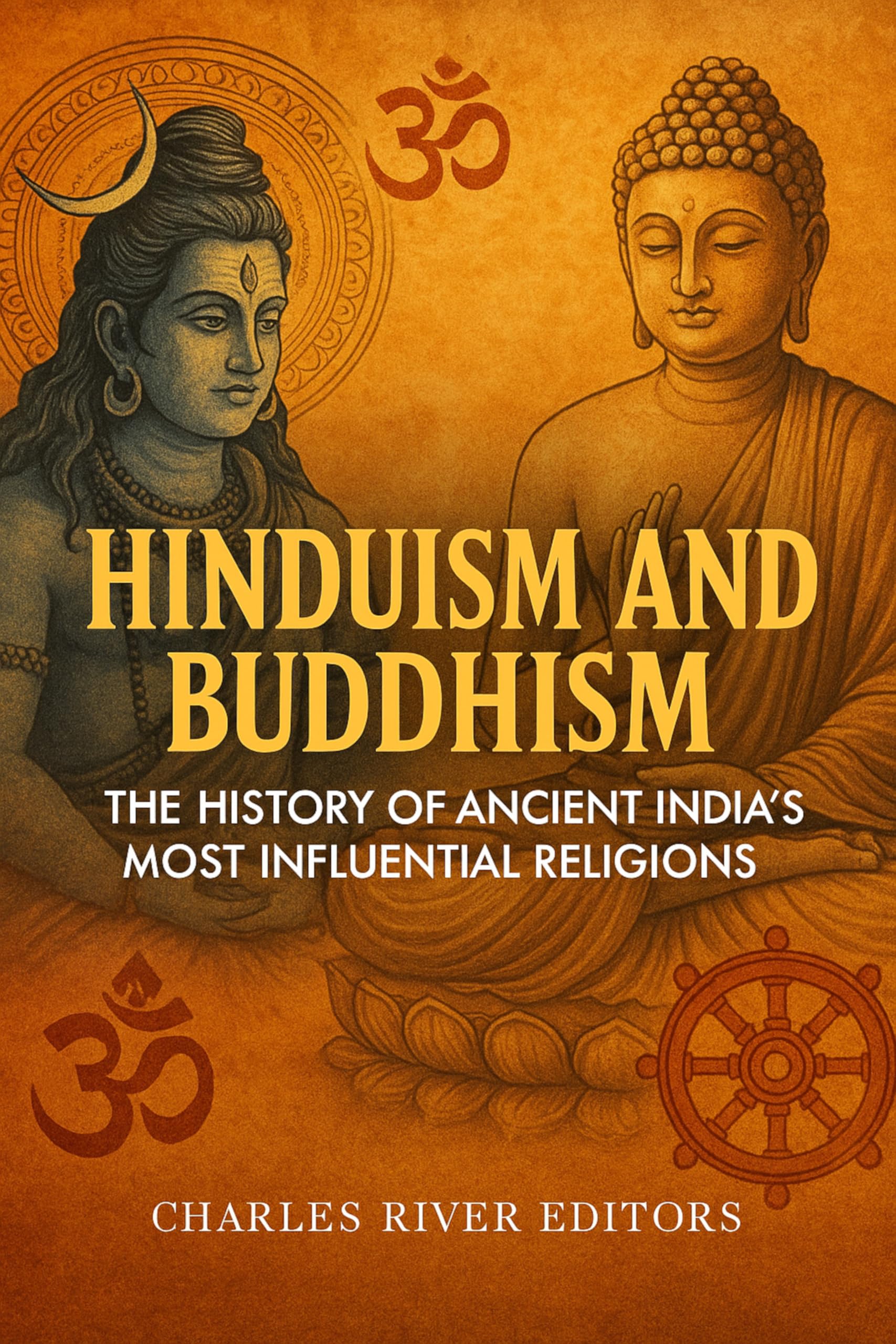
Hinduism and Buddhism: the History of Ancient India’s Most Influential Religions
$0.00$5.99
Explore the rich history of the Indus Valley Civilization, its impact on Indian religion, and the complex evolution of Hinduism and Buddhism over thousands of years.