As one of the most influential and recognizable religious figures in history, Martin Luther continues to impact the world over 550 years after his death. Luther was a German priest and theologian whose writings and teachings sparked the Protestant Reformation in the early 16th century, creating one of the greatest schisms in the history of the Catholic Church and touching off religious turmoil and bloodshed that would engulf Europe for the next 2 centuries.Born shortly after the invention of the printing press, Luther became one of Europe’s best selling authors, along with others like Erasmus, and his theology was mass produced across Europe. He strongly disputed the claim that freedom from God’s punishment of sin could be purchased with money, known as indulgences, and he confronted indulgence salesman Johann Tetzel with his 95 Theses in 1517, one of the most important religious writings of all time. His refusal to retract all of his writings at the demand of Pope Leo X in 1520 and the Holy Roman Emperor Charles V at the Diet of Worms in 1521 resulted in his excommunication by the Vatican and condemnation as an outlaw by the emperor.Luther, of course, did not back down. Although the story about him nailing 95 Theses to a church door is almost surely apocryphal, Luther continued that salvation is not earned by good deeds but received only as a free gift of God’s grace through faith in Jesus Christ as redeemer from sin. His theology also continued to directly challenge the Pope’s authority by teaching that the Bible is the only source of divinely revealed knowledge.That said, the Protestant Reformation, despite often being associated with the symbolic figure of Martin Luther nailing his 95 Theses to the door of the Castle Church in Wittenberg on October 31, 1517, cannot be reduced to a single, abrupt, and exceptional event. Rather, it must be traced to a much longer process of spiritual, social, and intellectual transformation that unfolded over the late medieval period. This historiographical perspective acknowledges the deep-rooted need for a Reformation, transforming the period between the 14th and 16th centuries into a genuine “Age of Reformation.”[1] Authors such as Eric Leland Saak emphasize that criticisms of ecclesiastical authority and calls for reform (sola scriptura) were already evident in the preceding centuries. In fact, reformers John Wycliffe and Jan Hus, who lived several decades before Luther, anticipated central themes of the Reformation, laying the foundations for a critique, making Luther’s actions not the beginning of a secular movement but the culmination of it.The popular image of the Reformation is largely a retrospective construction centered on the posting of the 95 Theses (Thesenanschlag). Historian Peter Marshall describes this act as “one of the greatest recorded moments in Western history,” a moment which some argue marked the end of the Middle Ages and the affirmation of the right to freedom of conscience. However, although this event is remembered, Marshall himself argues that the public posting of the Theses, as often portrayed, “most likely never took place.” In his extensive correspondence and autobiographical writings, Luther never mentions personally posting the Theses, suggesting that the event was more symbolic than real. Luther’s original intention was to promote academic disputation, which was a common practice in universities. The Theses themselves were intended to be discussed, not to be taken as a dogmatic manifesto, and Luther “did not intend to abuse or injure anyone.” The establishment of October 31, 1517, as a key date and its transformation into a seminal historical event were a process that began not only with modern historians but also a few years after Luther’s time.
save
$2.99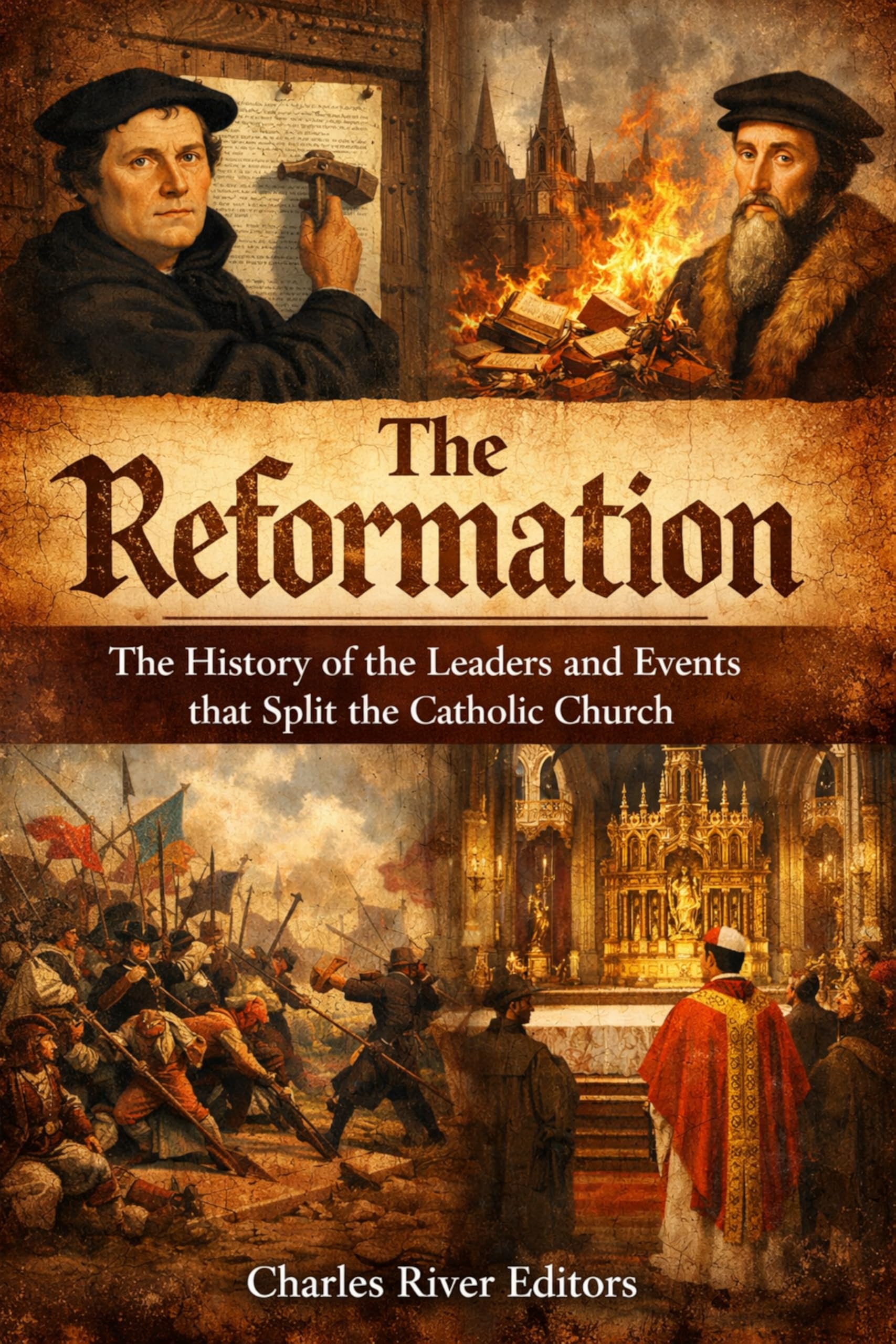
The Reformation: the History of the Leaders and Events That Split the Catholic Church
$0.00$2.99
Discover the life of Martin Luther, a pivotal figure who sparked the Protestant Reformation by challenging the Church’s practices, promoting faith, and reshaping religious history in Europe.