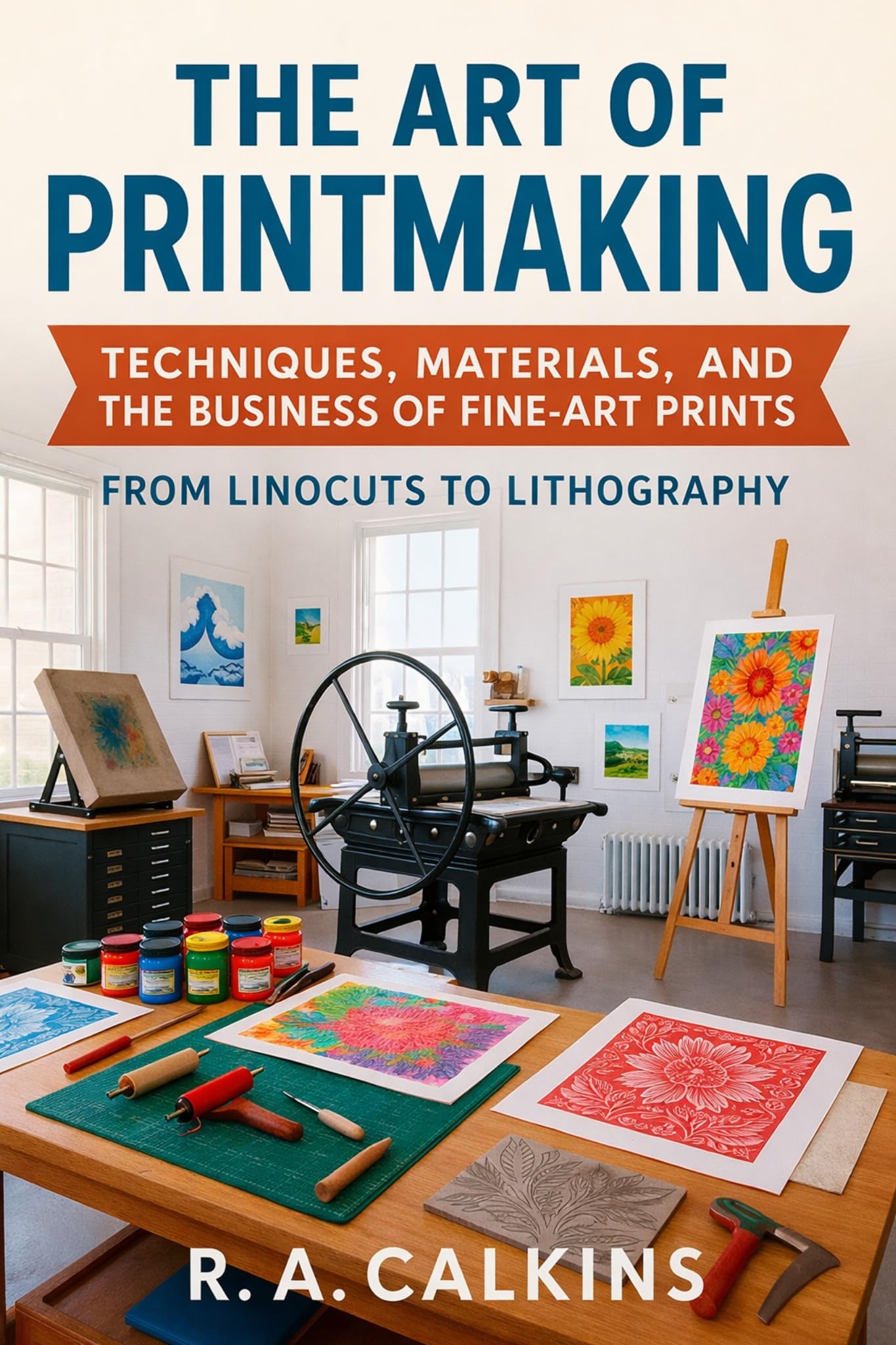
The Art of Printmaking: Techniques, Materials, and the Business of Fine-Art Prints — From Linocuts to Lithography
This is a single, practical handbook for artists who want reliable technique, honest documentation, and a sustainable studio practice. Beginning with the core idea of what a print is — an original work that exists as a controlled series or a unique impression — the book lays a clear vocabulary and a dependable workflow that artists can return to whenever they need orientation or a checklist. It moves process by process, describing relief, intaglio, planographic, stencil/screen, monotype, and photomechanical/digital hybrids in terms that respect both hand skill and reproducible control.
Each process chapter gives decision guidance and tangible examples: when to choose bold relief for graphic silhouettes, when intaglio is required for fine line and rich blacks, how lithography yields painterly grays, and why serigraphy excels for vibrant color and large scale. Tools and consumables are itemized with practical price ranges and specifications — brayer widths and durometers, ink formulations, paper weights and fiber content, plate materials and common working sizes, and studio equipment options from a modest hand press to workshop presses. These lists let readers plan a home studio or scale up to a professional workspace without guesswork.
Workflows are written for the studio floor. Step-by-step sequences cover design transfer, carving and biting, registration for multicolor printing, inking and wiping techniques, press settings, hand printing methods, and curing or drying finishes. Troubleshooting sections diagnose common failures—ghosting, poor registration, uneven ink laydown, and plate wear—and prescribe corrective habits to prevent recurrence. Safety and studio management are integrated: ventilation, chemical handling, safer solvent choices, waste disposal, respirators, fire prevention, and storage protocols described in actionable terms.
Because editioning is central to a print’s value, the book treats documentation and ethics with specific forms and conventions: edition numbering, trial and artist’s proofs, state proofs and plate changes, signature and authentication conventions, and the ledger entries that record materials, methods, and dates. A conservative, reproducible pricing method walks through materials, labor (hourly breakdown), overhead, and markup so readers can produce defendable retail prices. Distribution options—galleries, fairs, online sales, and studio consignment—are covered alongside practical business tips for contracts, consignments, and recordkeeping.
Advanced chapters explore professional techniques that reward extended practice: viscosity printing, chine-collé, photogravure and photopolymer plates, large-scale screenprinting, and collaborative printing with master printers. Every technical chapter closes with targeted exercises—repeatable projects such as ten small linocuts, a multi-bite etching test, and a three-color reduction print—designed to convert trial into reliable skill.
Written for students, independent artists, and workshop professionals, this book is a working reference: checklists, sample templates, and studio protocols make it a manual you will return to as your practice matures. Its aim is simple: replace guesswork with reproducible technique, replace opacity with clear editioning, and give artists the tools to present prints with technical confidence and ethical transparency.