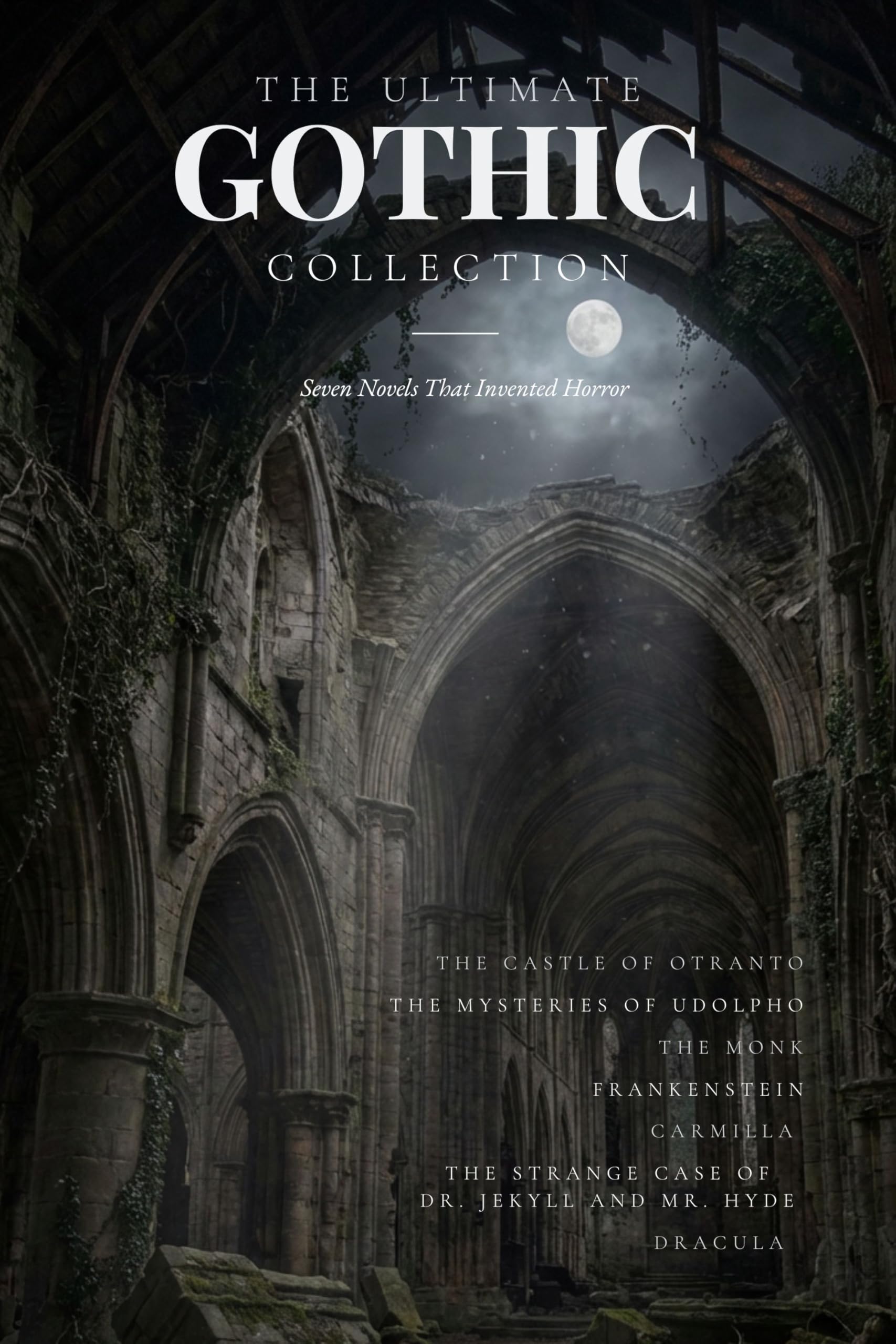
Seven novels. One hundred and thirty-three years. The complete invention of horror.
Edited with a critical introduction and biographical essays by Henry Bugalho — philosopher, writer, and Fellow of the Royal Society of Arts. Published by Erato Press.
This is the definitive collection of the novels that created gothic fiction — from the genre’s explosive birth in 1764 to its dark culmination in 1897. Seven works that gave Western literature its monsters, its haunted houses, its forbidden desires, and its deepest fears. Before there was horror, there was this.
✦ The Castle of Otranto — Horace Walpole (1764) — The novel that started everything: a giant helmet falls from the sky, a father pursues his dead son’s bride, and a castle begins to destroy itself. Clumsy, feverish, and irresistible — the primal scene of Gothic fiction.
✦ The Mysteries of Udolpho — Ann Radcliffe (1794) — The longest and most atmospheric novel in the collection. Emily St. Aubert, imprisoned in a castle in the Apennines, faces terrors that are always almost supernatural — and all the more frightening for it. Radcliffe invented the Gothic heroine and the art of imagining what is behind the locked door.
✦ The Monk — Matthew Gregory Lewis (1796) — Written by a nineteen-year-old, and it shows — in the best possible way. A holy man’s descent through every conceivable transgression. The most scandalous novel of its century and the book that proved the Gothic could not be contained by good taste.
✦ Frankenstein — Mary Shelley (1818) — An eighteen-year-old woman created the modern myth. A scientist builds a creature and abandons it. The creature learns to speak, to read, to suffer — and returns to ask the question that still haunts us: who is the real monster? This collection brings the 1831 definitive edition.
✦ Carmilla — Joseph Sheridan Le Fanu (1872) — Before Dracula, there was Carmilla — a female vampire who seduces rather than attacks, who whispers rather than bites. The most intimate and unsettling vampire story ever written, and the one that Stoker studied before writing his own.
✦ The Strange Case of Dr. Jekyll and Mr. Hyde — Robert Louis Stevenson (1886) — The story everyone knows but few have actually read. Stevenson’s novella is shorter, stranger, and more disturbing than any adaptation — a horror story about what happens when the self is not one but two.
✦ Dracula — Bram Stoker (1897) — The novel that sealed the Gothic tradition and created its most enduring monster. Told entirely through letters, diaries, and newspaper clippings, Dracula is a novel about desire disguised as a novel about fear — and it has never been surpassed.
THE ARCHITECTURE OF DREAD — A Critical Introduction by Henry Bugalho
This edition opens with an original critical essay of unprecedented scope — seventeen chapters tracing the hidden structures that connect all seven novels: the monstrous father, the imprisoned woman, the secret that cannot stay buried, the body that rebels against the mind. Why does Gothic fiction always return to the same house? Why does the monster always speak? And what does it mean that the genre born to frighten us is also the genre that most honestly confronts desire, power, and the limits of the human?
THIS EDITION INCLUDES: ✦ Seven complete, unabridged novels spanning 133 years of Gothic fiction ✦ A critical introduction of seventeen chapters by Henry Bugalho ✦ Biographical essays on each of the seven authors ✦ Professional formatting for Kindle
For readers who love: Gothic fiction • Frankenstein • Dracula • Horror classics • Dr. Jekyll and Mr. Hyde • Carmilla • Vampire fiction • Dark romance • Classic British literature • Horror anthology • Literary collections with critical analysis