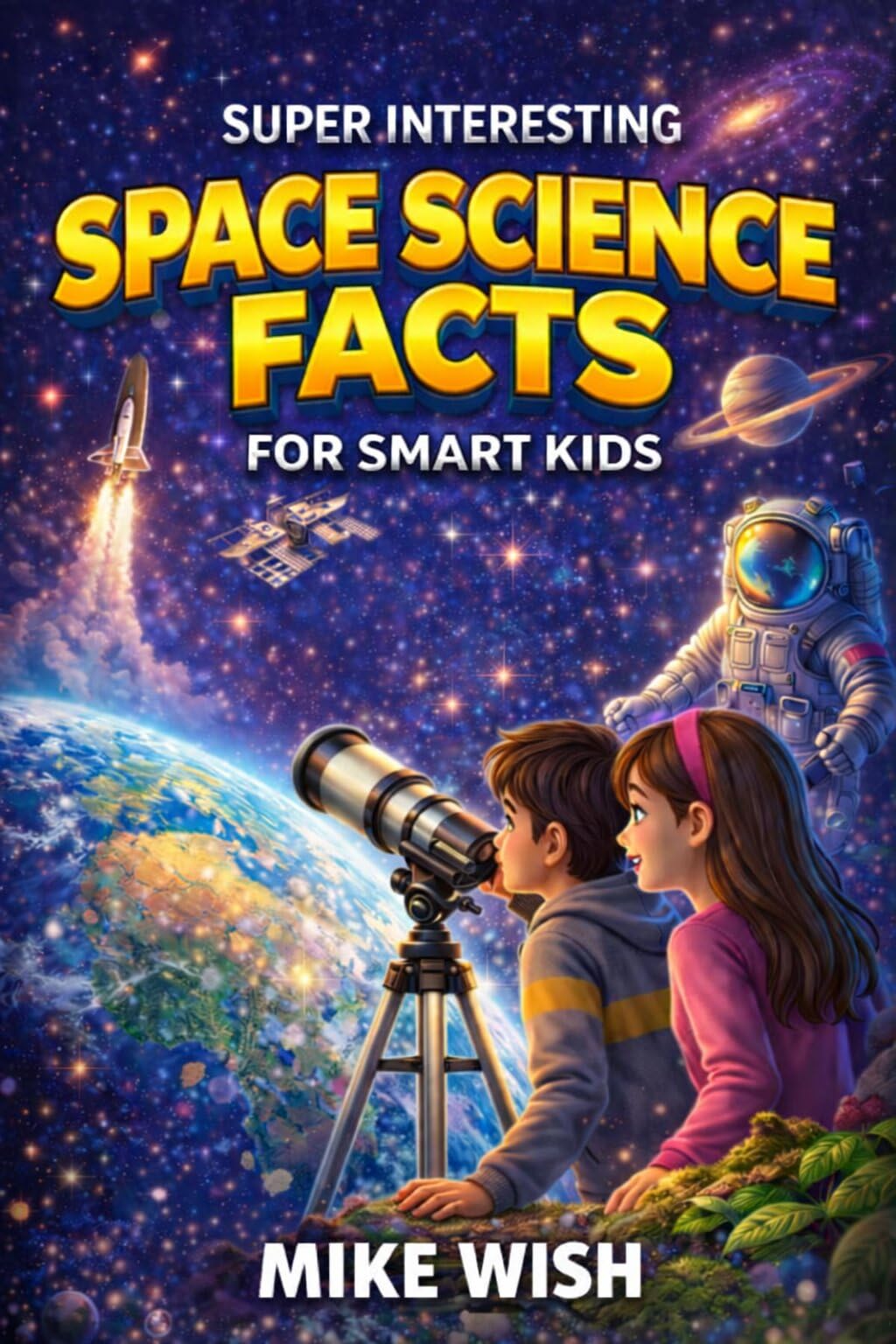
Does your child stare at the night sky and want to know what’s actually out there?
From the man who pointed a homemade telescope at Jupiter and spotted moons no human had ever seen to the spacecraft that crossed into interstellar space and kept sending signals back, the universe is full of stories that sound made up but aren’t. This book cracks open the science of space with over 400 fascinating facts, true stories of discovery, and questions that will get the whole family thinking.
Here’s a taste of what’s inside:
Why Venus is hotter than Mercury even though it’s farther from the Sun, with surface temperatures high enough to melt leadThe storm on Jupiter that’s wider than the entire Earth and has been raging for centuriesHow a volcano on Mars stands three times taller than Mount Everest and so wide you couldn’t see across it past the planet’s curveWhy all eight planets in the solar system could fit side by side in the gap between Earth and the MoonThe shrimp-sized creature on Saturn’s moon that scientists think could be swimming in an ocean buried under miles of ice (and why NASA is building a mission to check)How a dying star can collapse into an object so dense that a single teaspoon of it would weigh more than a billion tonsThe planet where it rains glass sideways at thousands of miles per hourEach chapter opens with a true story about a real scientist and the moment everything changed. You’ll meet Galileo, sketching tiny dots of light by candlelight and realizing he’d just proven the universe doesn’t revolve around us. You’ll watch Cecilia Payne, a young graduate student, figure out what stars are actually made of while her own professors told her she had to be wrong. And you’ll follow the engineers who aimed a spacecraft at where Pluto would be nine and a half years in the future, then nailed the flyby.
Written by a physics teacher and former instructor at the US Naval Academy, every fact is accurate, clearly explained, and built to stick. No filler. No fluff. Just real science that makes kids say, “Wait, seriously?”
Each chapter also includes rapid-fire “Did You Know?” facts and open-ended “Think About It” questions designed to spark real conversations, not just right answers.
Perfect for curious readers aged 8 to 12 who devour science books, love surprising facts, and want to understand how the universe actually works. (Parents and grandparents: you’ll learn something too.)
This is the book for the kid who wants to know what’s inside a black hole, whether aliens might be out there, and how a golden record on a spacecraft launched in 1977 is still hurtling toward the stars carrying the sounds of Earth. Whether it’s a gift, a road trip companion, or a bedtime “just one more fact” book, it turns curiosity into real knowledge.
The scientists in these pages didn’t start with answers. They started with questions. This book will give your child 400 reasons to do the same.