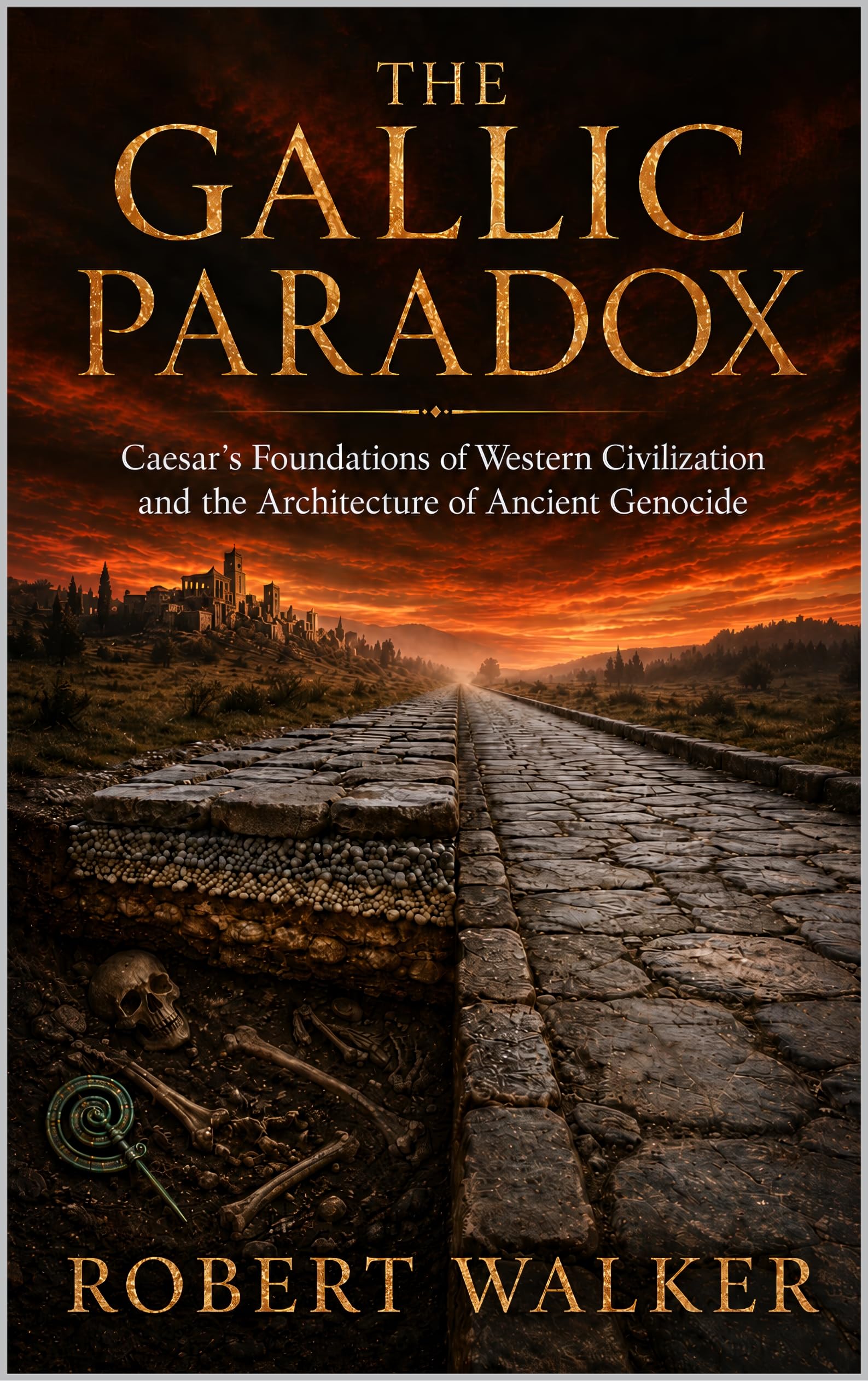
The sentence that launched a thousand classrooms also launched a genocide.
Gallia est omnis divisa in partes tres. All Gaul is divided into three parts.
For two millennia, students have parsed this sentence as a masterpiece of Latin prose. They were never told it was a declaration of ownership — the opening move of a campaign that would kill one million people, enslave one million more, and erase sixty tribal nations from the map of Europe.
The Gallic Paradox tells both stories simultaneously.
Through meticulous historical research and visceral narrative power, Robert Walker reconstructs the world Caesar destroyed alongside the machine he built to destroy it. A Helvetian metalworker watches her people burn their own city rather than leave it for Rome. A Gallic druid preserves twenty years of memorized law in a tradition that has no page for the Romans to seize. A mother in a refugee camp hears a Roman horn and knows — in her body, before her mind — what the sound means.
Against these voices, Caesar’s own words unspool in elegant third person — recording the sieges, the massacres, the engineered famines, and the systematic eradications with the detached syntax of a man filing a provincial expense report.
Inside this book, you will discover:
How Caesar manipulated Rome’s deepest national trauma to authorize an illegal war of conquestThe sophisticated civilizations — with currencies, senates, trade networks, and legal systems — that the word “barbarian” was designed to eraseThe massacre of 400,000 refugees that Caesar recorded in six sentences and Roman senators tried to prosecute as a war crimeHow the Commentarii functions simultaneously as history’s most important account of the conquest and the most sophisticated instrument of its erasureThe engineered starvation at Alesia, where Caesar trapped civilians between two walls and let them die to break a siegeWhy the paradox at the center of Western civilization — achievement and atrocity in the same sentence — remains irresolvableThe Gallic Paradox is narrative history that reads like a thriller and cuts like an indictment. It does not simplify Caesar into a hero or a monster. It holds both truths in the same hand and asks the reader to do what two thousand years of classical education has carefully avoided: look at the whole picture.
Part of The Moral Complexity Series — historical works that examine the figures and events the traditional narrative has simplified, where admiration and horror occupy the same sentence.