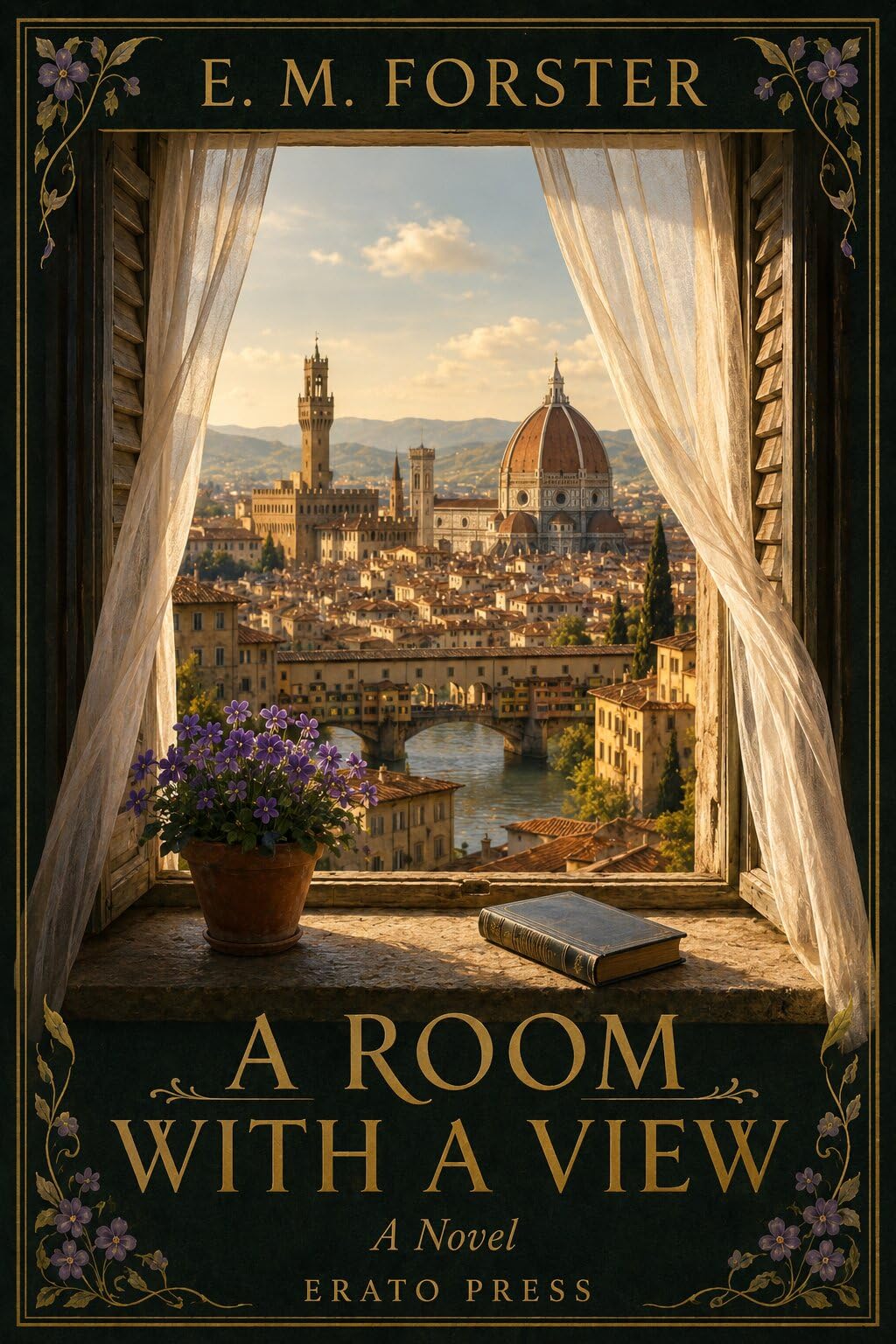
A young woman, a forbidden kiss in a field of violets, and one of the most beloved romantic comedies in English literature.
When Lucy Honeychurch travels to Florence with her fussy older cousin as chaperone, she is given a room without a view — and then, by two eccentric English gentlemen, a room with one. So begins E. M. Forster’s luminous comedy of manners, a novel about the war between what society expects and what the heart actually wants, between the cramped rooms of English convention and the open windows of Italian passion.
First published in 1908, A Room with a View remains Forster’s sunniest and most widely loved novel — the book behind the beloved Merchant-Ivory film, and a perennial favorite of readers who want intelligence and joy in the same volume.
The novel.
In Florence, Lucy meets the Emersons — father and son, freethinking, awkward, alive — and the young George Emerson kisses her, without permission, among the violets of the Tuscan hills. Back in England, Lucy becomes engaged to the priggish, cultivated Cecil Vyse, a man who collects people the way he collects art. But the Emersons reappear in the Surrey countryside, and Lucy must choose between the safe, suffocating life expected of her and the frightening, liberating truth of what she feels.
It is a comedy. It is also one of the most quietly radical novels of its age — a defense of honesty, of the body, of the view, against everything that would shut the window and draw the blinds.
Why this edition?
This Erato Press edition presents the complete 1908 text of A Room with a View, one of the founding novels of literary modernism’s more humane, Edwardian wing.
This edition includes:
The complete, unabridged 1908 text, in its two partsAn extensive critical essay by Henry Bugalho on Forster’s comedy, his humanism, and the novel’s place in Edwardian fictionA biographical portrait of E. M. Forster — Cambridge, Bloomsbury, the novels, the long silenceEditorial annotations on the novel’s Italian settings, allusions, and social worldDesigned for serious readers, students, and the classroom alikePart of the Classics of World Literature series — Erato Press.
About E. M. Forster (1879–1970)
Edward Morgan Forster published five novels in the first sixteen years of the twentieth century — Where Angels Fear to Tread (1905), The Longest Journey (1907), A Room with a View (1908), Howards End (1910), and, after a long gap, A Passage to India (1924) — and then, famously, almost no fiction for the remaining forty-six years of his life. Associated with the Bloomsbury Group and with King’s College, Cambridge, he became one of the most respected English novelists of his century, the author of the celebrated humanist credo “only connect.” His novels, several adapted into acclaimed films, remain among the best-loved works of English fiction.
A Room with a View is, for many readers, the place to begin — and the one they return to.
Part of the Classics of World Literature series — Erato Press.
“Let us rather love one another, and work and rejoice.”