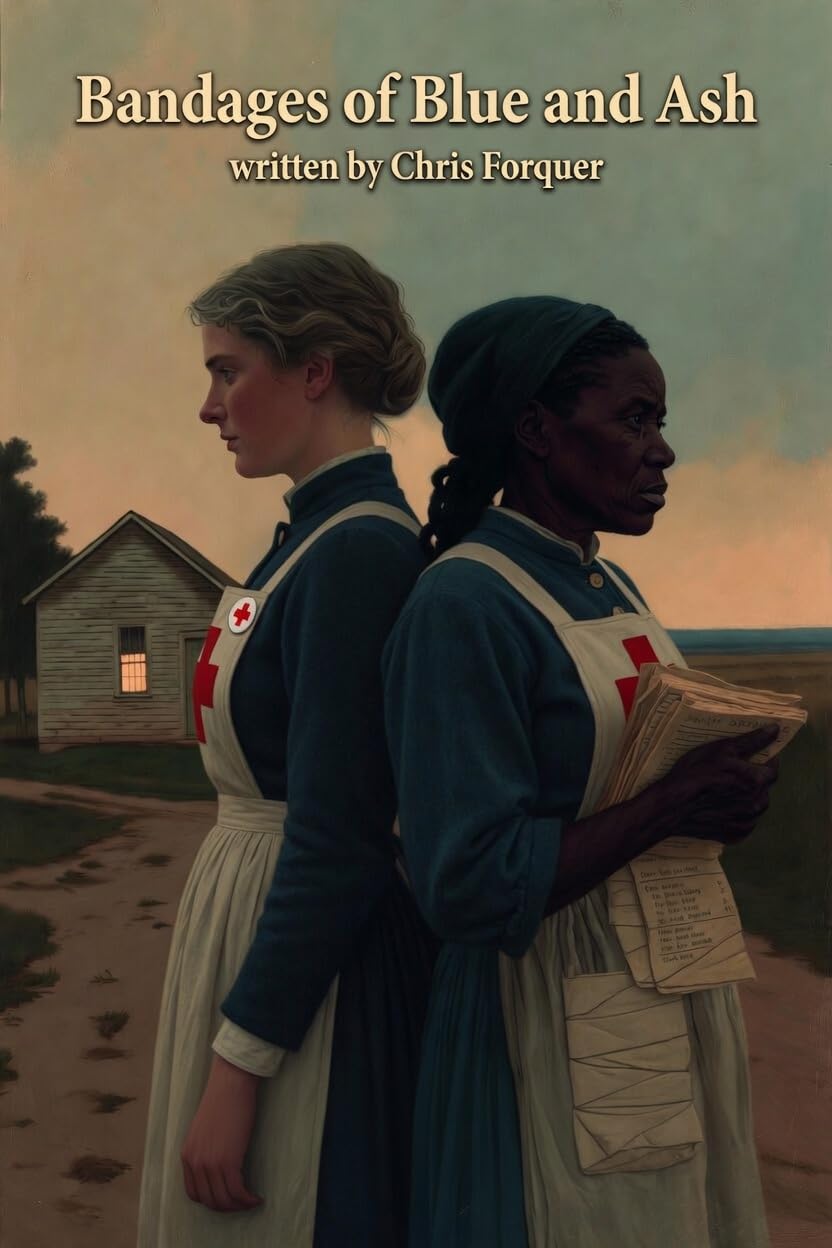
Set during the final years of the American Civil War and its fragile aftermath, this novel follows Eleanor Harper, a Union nurse, and Ruth Collins, a formerly enslaved woman turned logistics organizer, as they navigate war, emancipation, and the dangerous work of building freedom where institutions retreat.
Eleanor enters the war believing care can operate outside politics. Trained, disciplined, and shaped by prior moral compromise, she joins the Union medical service determined to save lives without challenging authority. Ruth, by contrast, learns early that survival depends on understanding systems—movement, supply, record‑keeping—and bending them when they refuse to serve human need. When their paths cross in a Union encampment, the bond that forms between them is quiet, deliberate, and forged through shared labor rather than declaration.
As the war grinds on, both women become indispensable—not because they seek power, but because they refuse to disappear. They witness the battlefield shift from movement to siege, from violence to endurance. Their partnership deepens amidst chaos, restraint, and watchful scrutiny, even as the costs of visibility rise. When the war ends, neither peace nor justice arrives cleanly. Instead, authority narrows its scope, withdrawing protection while claiming restraint.
In the postwar South, Ruth begins working with the Freedmen’s Bureau and quickly discovers its limits: aid entangled in bureaucracy, emancipation constrained by contracts and indifference, and local violence quietly absorbed by administration. Eleanor brings her medical practice into freed communities abandoned by federal follow‑through, treating disease, starvation, and injuries that no longer arrive wearing uniforms. Together, they confront a new enemy—not open battle, but order that stabilizes injustice.
The threat coalesces in the form of the Regulators—local night riders whose violence is carefully calibrated to intimidate without accountability. As Eleanor heals the wounded and teaches care outward, Ruth builds decentralized systems that survive without permission. Alongside them work conflicted allies within the Bureau: Anneke Vogel, a relentless archivist of consequences; Lydia Fairchild, an internal reformer; and Jonah Whitaker, a skeptic determined to record failure honestly rather than excuse it.
When Ruth exposes the Regulators’ secret—that their violence is quietly financed through county funds and administrative indirection—the conflict moves fully into daylight. The Bureau responds by withdrawing night protections; the town responds by refusing to retreat. Care continues without authorization. Memory is gathered publicly. Power begins to erode not through triumph, but through repetition and witness.
The novel culminates not in clean justice but in endurance. Authority survives, compromised but present. Violence loses coherence. Records circulate north, delayed but permanent. In the town, a clinic becomes something lasting—not by decree, but by use. Eleanor and Ruth settle into a life shaped by shared intention rather than secrecy, their love expressed through daily choice and mutual accountability.
In the end, the story offers no simple victory. Instead, it asks what it means to practice freedom when permission is unreliable—and answers quietly: freedom is not an event, but a commitment sustained by care, memory, and the refusal to vanish.