In the mid-14th century, the Vatican called upon England and sought financial aid in the hopes of boosting papal defenses against French forces. It was then that a man named John Wycliffe boldly stepped forth and appealed to the John of Gaunt, urging the Duke of Lancaster and Parliament to repudiate Rome’s demands and citing what he believed to be the Church’s abundance in wealth. According to Wycliffe, Christ’s disciples, particularly clergymen, must aspire to live modestly and shun all material pleasures. Such was the word of the Lord.While Wycliffe’s critics rejoiced at the news of his demise, they soon discovered that his influence was far more difficult to extinguish than they initially anticipated. In 1427, a whole 43 years after Wycliffe’s passing, his corpse was exhumed by local authorities and cremated, and the ashes were dumped into the River Swift, but Wycliffe’s indelible ideas had taken on a life of their own, and they would be championed by a Czech reformer named Jan Hus. The 17th century historian Thomas Fuller poetically described the ripple effect: “Thus the brook hath conveyed his ashes into Avon; Avon into Severn; Severn into the narrow seas; and they into the main ocean. And thus the ashes of Wycliffe are the emblem of his doctrine which now is dispersed the world over.”If Wycliffe was the “Morning Star of the Reformation,” Hus was the Guiding Star of the movement. Hus started as a Czech priest, but he quickly became notorious for debating several Church doctrines such as the Eucharist, Church ecclesiology, and many more topics. Today, he is viewed as a predecessor of the Lutherans, but the Church viewed him as a threat, and the Catholics eventually engaged Hus’ followers (known as Hussites) in several battles in the early 15th century. Hus himself was burned at the stake in 1415, but his followers fought on in a series of battles known as the Hussite Wars, and Czechoslovakia’s inhabitants by and large remained Hussite afterward. About 100 years later, reformers like Martin Luther, John Calvin, and Ulrich Zwingli would help spark the Reformation across the continent.As one of the most influential and recognizable religious figures in history, Martin Luther continues to impact the world over 550 years after his death. Luther was a German priest and theologian whose writings and teachings sparked the Protestant Reformation in the early 16th century, creating one of the greatest schisms in the history of the Catholic Church and touching off religious turmoil and bloodshed that would engulf Europe for the next 2 centuries.Born shortly after the invention of the printing press, Luther became one of Europe’s best selling authors, along with others like Erasmus, and his theology was mass produced across Europe. He strongly disputed the claim that freedom from God’s punishment of sin could be purchased with money, known as indulgences, and he confronted indulgence salesman Johann Tetzel with his Ninety-Five Theses in 1517, one of the most important religious writings of all time. His refusal to retract all of his writings at the demand of Pope Leo X in 1520 and the Holy Roman Emperor Charles V at the Diet of Worms in 1521 resulted in his excommunication by the Pope and condemnation as an outlaw by the emperor.John Calvin was one of the most important religious figures of the last millennium and an instantly recognizable name across the globe. Calvin was an influential French theologian and pastor during the Protestant Reformation, and the period when he was most active, the 1530s and 1540s, was marked by increased complexity and the diffusion of the Reformation into several branches. Alongside Martin Luther, Calvin was one of the central Reformers, and after fleeing to Basel, Switzerland, he published the Institutes of the Christian Religion in 1536.
save
$6.99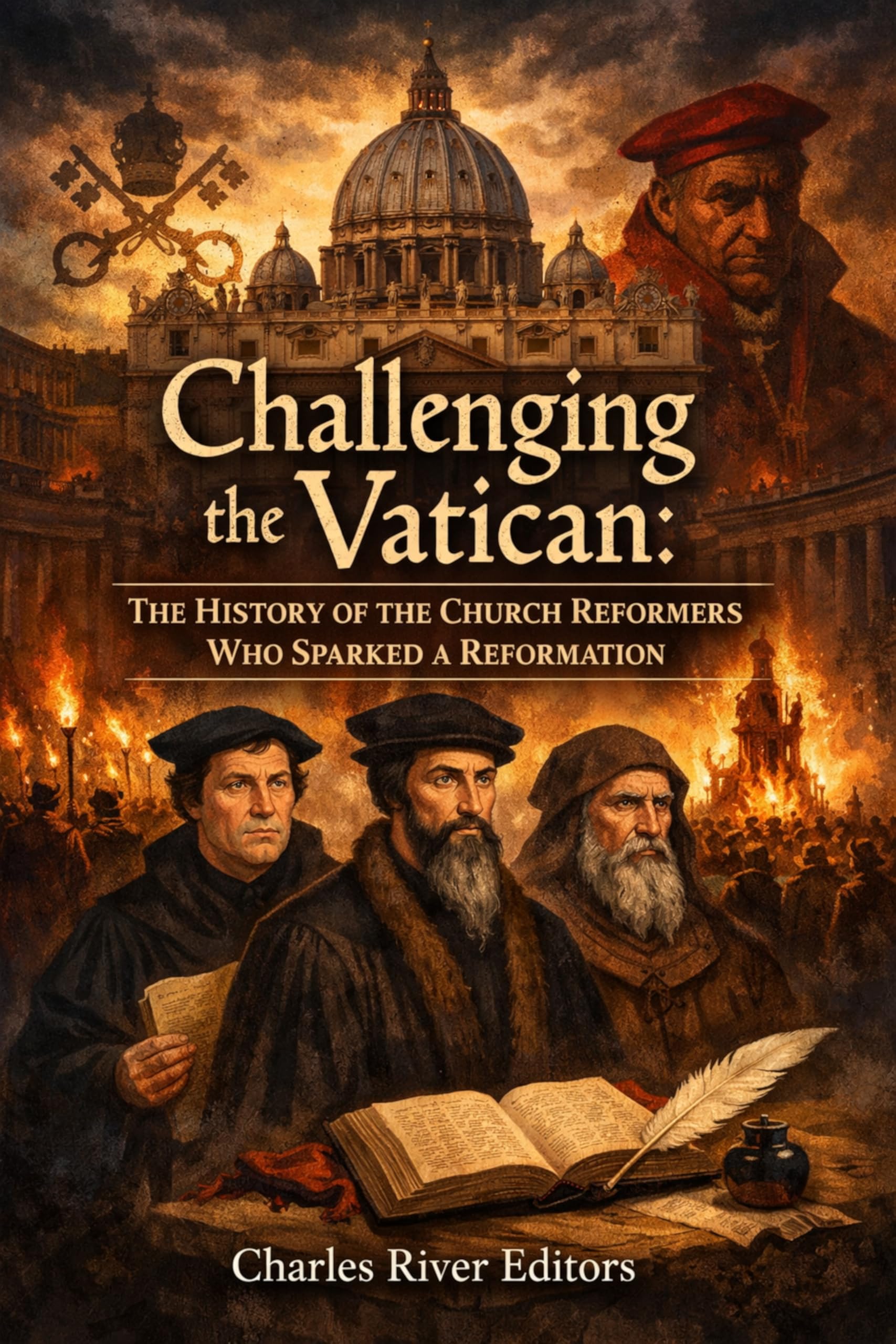
Challenging the Vatican: the History of the Church Reformers Who Sparked a Reformation
$0.00$6.99
Explore the transformative journeys of John Wycliffe, Jan Hus, Martin Luther, and John Calvin, pivotal figures in the Protestant Reformation who challenged the Catholic Church’s authority and reshaped Christianity.