The story of the ancient Israelites in Egypt is one of the most famous stories in the world, and one of the most contentious from a historical standpoint. Today, most people know about the relationship between the ancient Israelites and the Egyptians from the Old Testament book of Exodus, and the numerous feature films that often depict the dealings between the two peoples in contentious ways. The deadly plagues, the crossing of the Red Sea, the arduous 40 years the Israelites spent in the desert, and the Ten Commandments all make the Exodus unforgettable, but they’ve also left generations of scholars wondering just how accurate the Scripture is, with some seeking to prove the historicity of the account and others trying to tie it to the Babylonian exile of the Israelites in the 7th century BCE.The story of the Israelites in Egypt begins in the first book of the Old Testament, Genesis, when the Israelites were known as Hebrews, and ends after Egypt passed under foreign rule and the Israelites became known by their more modern appellation: Jews. The Old Testament provides the backbone of the ancient sources for the story of Israelite-Egyptian relations, but archaeological evidence from Egypt and the Levant, along with textual sources from Egypt and Mesopotamia, also provide a fuller picture of the two peoples’ geopolitical interactions. A study of the sources reveals that ancient Israelite-Egyptian relations were truly complex, and that the events of the Exodus were merely just a few in a series that ebbed and flowed, according to the desires and abilities of either people. Both the Israelites and Egyptians used their relationship with the other in order to obtain wider geopolitical objectives in the ever-changing world of the late Bronze Age and early Iron Age Near East.Before the Hebrews established a kingdom and before the Phoenicians colonized much of the Mediterranean, the Canaanites were the most important group in the Levant for much of the Bronze Age and into the early Iron Age. Although the Canaanites never created a unified nation-state or kingdom, their importance in the ancient Near East cannot be understated. It was at least partially because of that fact that the Canaanites were unable to resist their larger and more powerful neighbors that the average person today knows so little about their history, but modern studies have revealed that they developed a unique religion that influenced non-Canaanite peoples and continued to be practiced in some form centuries after the Canaanites ceased to be an identifiable people. Furthermore, during the height of the Bronze Age the Canaanites provided important resources to the Egyptian and Hittite Empires and played a key role in the geopolitical game of chess between those two kingdoms. It also goes without saying that the Canaanites were also a factor in the establishment of the Kingdom of Israel, as the battles they lost to the Hebrews later became the foundation of the Jewish kingdom.Eventually, the separate Hebrew tribes united together as a type of confederation, allies who made a treaty (covenant) to provide military aid for one another when threatened by an enemy state. But it was only under the charismatic leadership of David that the 12 tribes united into a single political entity. Scholars refer to the period encompassing the reign of David and his son Solomon as the United Monarchy. This period, spanning only two generations, was the only time when all of the tribes were politically united, and after a contentious schism that resulted because the northern tribes felt exploited by the Judean kings, the northern tribes seceded from the “United Kingdom” and reverted back to the ancient northern versus southern division of the tribes. The main difference this time was that the southern kingdom now incorporated the tribe of Benjamin, located at the border between these two new nations, within its political borders.
save
$4.99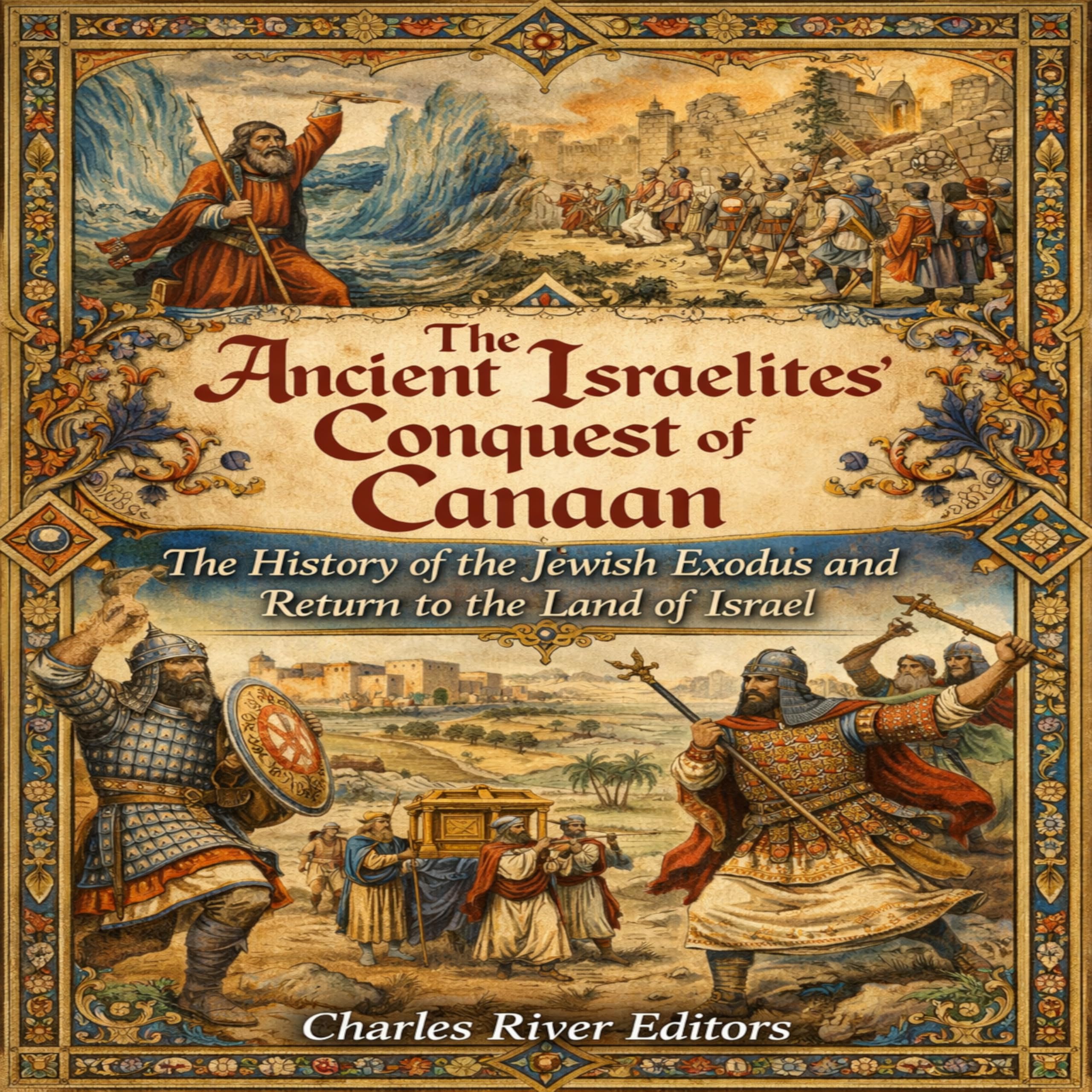
The Ancient Israelites’ Conquest of Canaan: the History of the Jewish Exodus and Return to the Land of Israel
$0.00$4.99
Explore the ancient relationship between the Israelites and Egyptians, uncovering their intertwined histories, conflicts, and cultural impacts, from the Old Testament to archaeological findings.