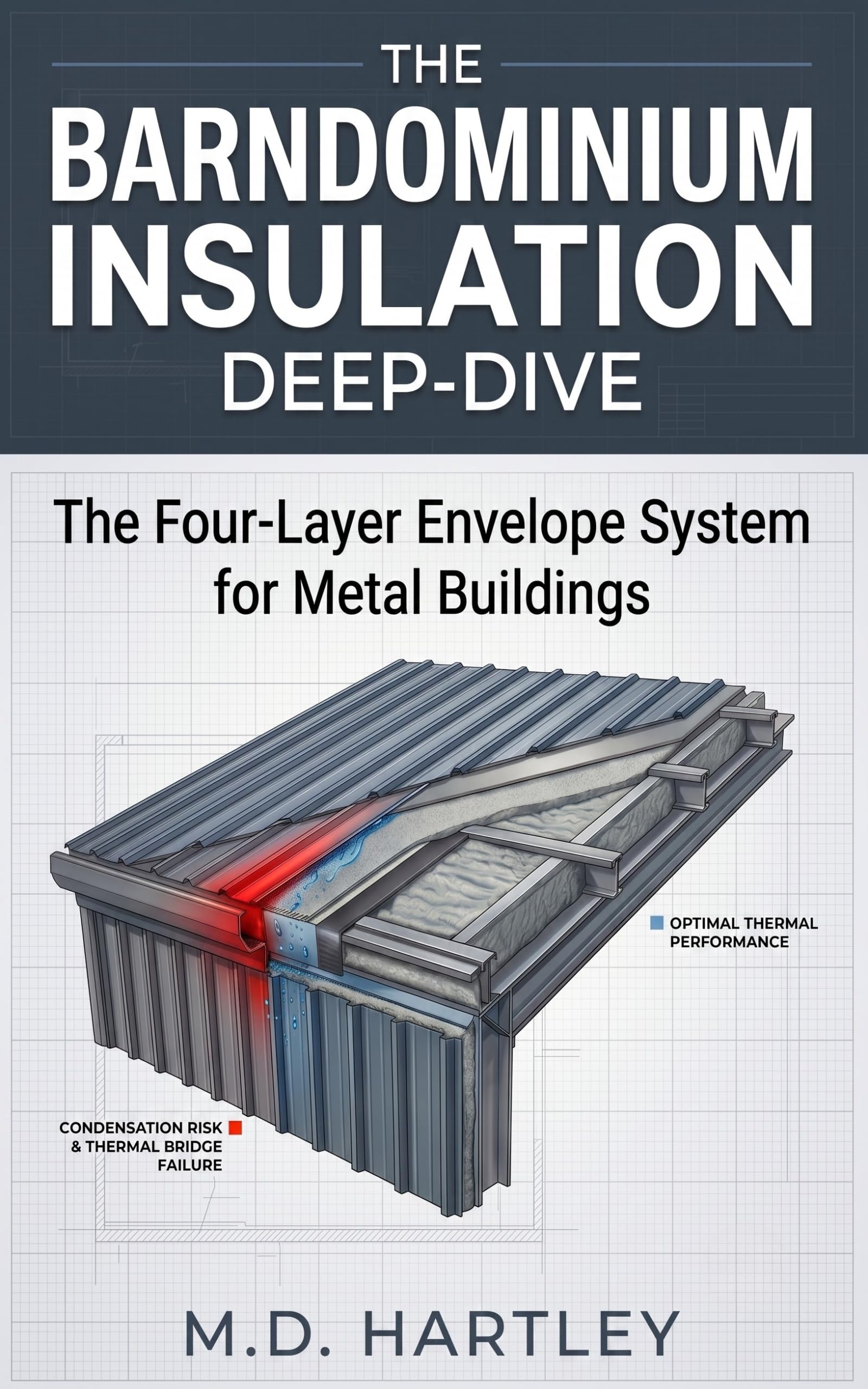
Why Barndominium Insulation Is DifferentSteel conducts heat approximately 385 times faster than wood. Every
metal column, girt, and purlin in a barndominium creates a direct thermal
pathway that bypasses the insulation around it — reducing effective R-value
by 30 to 50 percent in unaddressed metal-frame construction. A barndominium
insulated with the same products and R-values as a stick-frame house of the
same size will underperform that house, not because the insulation is bad
but because the metal frame is doing something wood doesn’t do.
Open-cell spray foam — the default specification in many barndominium
markets — is vapor-permeable. Moisture diffuses through it. In humid
climates, exterior moisture drives inward through the permeable foam and
condenses on the cold metal surface behind it. In cold climates, interior
moisture drives outward through the foam and condenses at the foam-metal
interface. Open-cell foam cannot prevent this in either direction.
The insulation decision is also permanent in a way that most
construction decisions aren’t. You can repaint the walls and replace the
floor. Insulation that has been sprayed into a wall or roof cavity and
covered with liner panels requires major demolition to access. Getting it
wrong means getting it expensively wrong, years after the fact, when the
symptoms finally become visible.
The Four-Layer EnvelopeA barndominium that performs correctly — energy-efficient,
moisture-free, comfortable across the full building — is one where four
specific layers of the building envelope have each been correctly specified
and installed:
Layer 1: The Roof Assembly — The highest-priority insulation
location. Closed-cell spray foam, applied continuously across purlins (not
just between them), is the correct specification in all climate zones.
Everything else in this system builds on getting this right.Layer 2: The Wall Assembly — Post-frame wall cavities span
multiple feet between framing members. Fiberglass batts don’t perform well
in wide openings; spray foam does. Climate zone determines product choice
and thickness.Layer 3: The Thermal Break — The deliberate interruption of the
metal frame’s thermal conducting path. Without continuous insulation across
the framing members (not just between them), the framing becomes a network
of thermal highways that short-circuit everything else. Cannot be
retrofitted after interior finish is installed.Layer 4: The Slab Edge — The most commonly missed layer.
Concrete at the slab perimeter is in direct thermal contact with the
exterior. Cold floors, floor-level condensation in humid climates, and
energy loss. Must be specified before the concrete is poured.The Specification That Protects You”Spray foam insulation throughout” is not a specification. It is a
category description that permits open-cell foam in your roof. A complete
insulation specification has five required elements: product type by
location, minimum installed thickness by location, complete coverage
requirement, thermal break requirement, and verification method. This book
provides a complete specification template, ready to become an exhibit in
your builder contract.
This book is part of The Barndominium Builder’s Library Problem-Solver
Series. It covers one subject only: the insulation system that determines
a barndominium’s energy performance and moisture safety for its entire
lifetime. Reads as a standalone guide for any barndominium buyer in the
design or pre-framing phase.