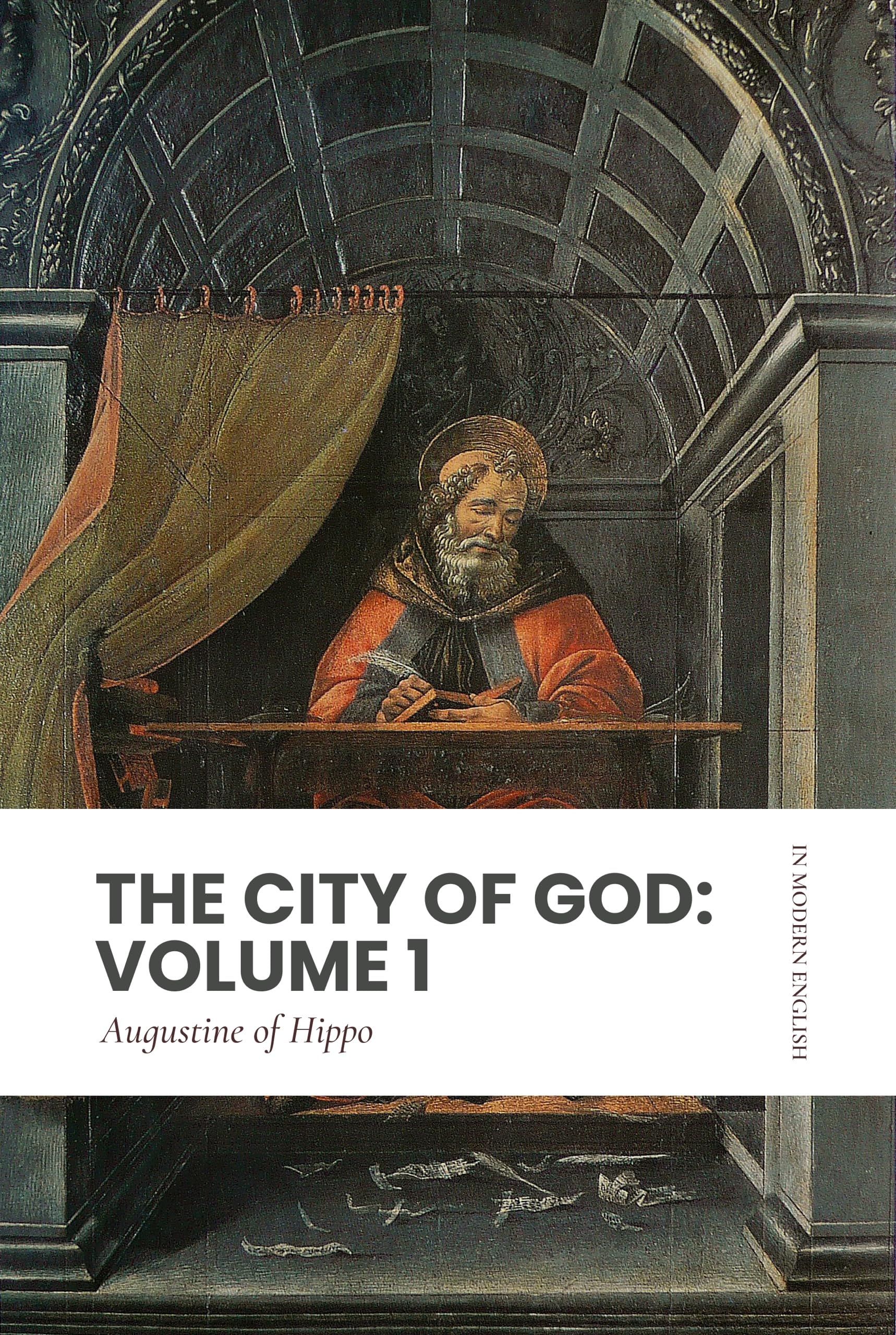
The City of God is Augustine of Hippo’s theological masterpiece and magnum opus, a twenty-two book defense of Christianity written after the Visigoths sacked Rome in 410 AD that became the foundational text of Western political theology and the philosophy of history, shaping Christian thought more than any other post-apostolic work.
We have updated this timeless classic (from the original text) into a modern, updated translation that is easier to read and understand!
Volume 1 contains Books 1 through 13, covering Augustine’s direct response to pagan critics who blamed Rome’s fall on the abandonment of the old gods, his sustained engagement with Greek and Roman philosophy, and the origins of his great vision of the two cities that divides all of human history.
What distinguishes the City of God is the extraordinary scope of its argument. Augustine moves effortlessly from historical polemic to philosophical analysis to biblical exegesis, weaving Roman history, Greek philosophy, and Christian theology into a single unified vision of providence, evil, and human destiny. Unlike purely defensive apologetics or abstract systematic theology, Augustine builds a comprehensive account of reality in which every civilization, every soul, and every moment participates in one of two cities — one built on the love of God and the other on the love of self. His synthesis shaped the Latin West’s conception of history, politics, and the Church for more than a millennium.
Books 1 through 10 dismantle the pagan case against Christianity. Augustine shows that Rome’s own gods never protected the city from disaster, that Roman history is a catalog of calamities predating Christianity, and that the pagan rites offered no moral or civic benefit even on their own terms. He then turns to the philosophers, especially the Platonists, whom he regards as having seen much that is true about God. Yet without Christ, philosophy cannot deliver what it glimpses. Augustine’s engagement with Plato, Porphyry, and the neo-Platonic tradition remains one of the most consequential philosophical encounters in Western thought.
Books 11 through 13 open Augustine’s positive theology of the two cities. He traces their origins to the creation and fall of the angels, explores the nature of time and eternity, offers his mature account of evil as a privation rather than a substance, and examines how sin entered human nature through Adam. These books contain some of Augustine’s deepest philosophical writing, including his famous treatments of the will, original sin, and the goodness of creation. Volume 2 continues the story through human history and the consummation of both cities at the end of the age.
Author BiographyAugustine of Hippo (354-430 AD) was a theologian and philosopher whose writings shaped Western Christianity more than those of any other post-apostolic figure. Born in Roman North Africa, he spent his early years pursuing rhetoric and philosophy before his dramatic conversion in 386 AD. As Bishop of Hippo for over thirty years, he produced an extraordinary body of work — including Confessions, The City of God, and On Christian Doctrine — that defined orthodox theology on grace, sin, the sacraments, and the interpretation of Scripture for centuries to come.