The most famous church in Jerusalem for nearly 2,000 years, the Church of the Holy Sepulchre, often called the Church of the Resurrection, was built in the era of St. Constantine, and the church as a structure has no history separable from the city of Jerusalem and its environs. It is venerated as being on the site where Jesus was crucified and buried, and naturally, making it a crucial pilgrimage site for Christians, and it is now the home of the Greek Orthodox Jerusalem Patriarchate. Moreover, it was the site of many important councils, some of which altered Christian history forever. In short, the Sepulchre was and is synonymous with Jerusalem, and it was essentially the nodal center of the city.Naturally, the Church has had a turbulent history just as Jerusalem has. Under the Emperor Vespasian, Jerusalem was attacked and depopulated by Roman forces in 70 A.D., and from 131-134, the Jewish revolt invited another Roman reprisal. Over and over again, Jerusalem has been decimated, sacked and razed. In 135, Hadrian rebuilt the city as a Roman outpost and called it “Aelia Capitolina” (Sicker, 2-3), and even the era of St. Constantine provided no respite from wars and dislocation. The Emperor Hadrian also removed Jews from the city upon its renovation (Sicker, 2-4).Underneath the pagan temple on the site before the Church of the Holy Sepulchre, workers found a Jewish cemetery where several caves lay with large, circular stones set in front as a means of blocking entry. Little doubt was expressed that it was the location of Christ’s burial because this was the only cemetery in the area, was of ancient origin, and several tombs were built just as the New Testament describes. Even more, these few tombs (4 out of 900) with the large front stone were rare in Judea at the time. Only a handful of the wealthy had them, but since the New Testament speaks of Nikodemus as a rich man, the location of Christ’s tomb was thought to be undoubtedly at this location (Berrett, 36ff). The evidence that Christ’s tomb was at that location was backed by the apostolic tradition and basic common sense. The local population had venerated this site since apostolic times, but so much had been destroyed in the ensuing centuries that records which might have been consulted were likely long lost already. The site is close to the Mount of Olives east of Jerusalem and the Holy Church of the Lord’s Hill, which lies to the west of it as a place particularly venerated by Christians. An artificial cave, located approximately 300 feet south of the hill, was certainly a burial crypt. The area around the cave itself suffered greatly from the Roman legionaries and the warfare there, so much has been lost, and the topography has changed radically since that time (Berrett, 35).The temple built by Constantine was demolished by Jewish militants in 614 under the protection of the Persian Empire. There was an earthquake in 746, and a devastating fire in 967. The temple continued to experience ups and downs that are endemic and essential to its history. In 1036, the Islamic government permitted the rebuilding of the church, and in 1048, Constantine Monomakh improved on the new structure. Thus, by the time the crusaders captured Jerusalem in 1099, they saw the church at the pinnacle of its glory. After the Crusaders famously conquered Jerusalem at the end of the 11th century, over the ensuing centuries, Christians and Muslims were embroiled in one of the most infamous territorial disputes of all time, viciously and relentlessly battling one another for the Holy Land. Of course, this made the Church of the Holy Sepulchre a perfect target, so much so that a powerful company of knights was founded to guard the church and defend its presence with their lives.
save
$4.99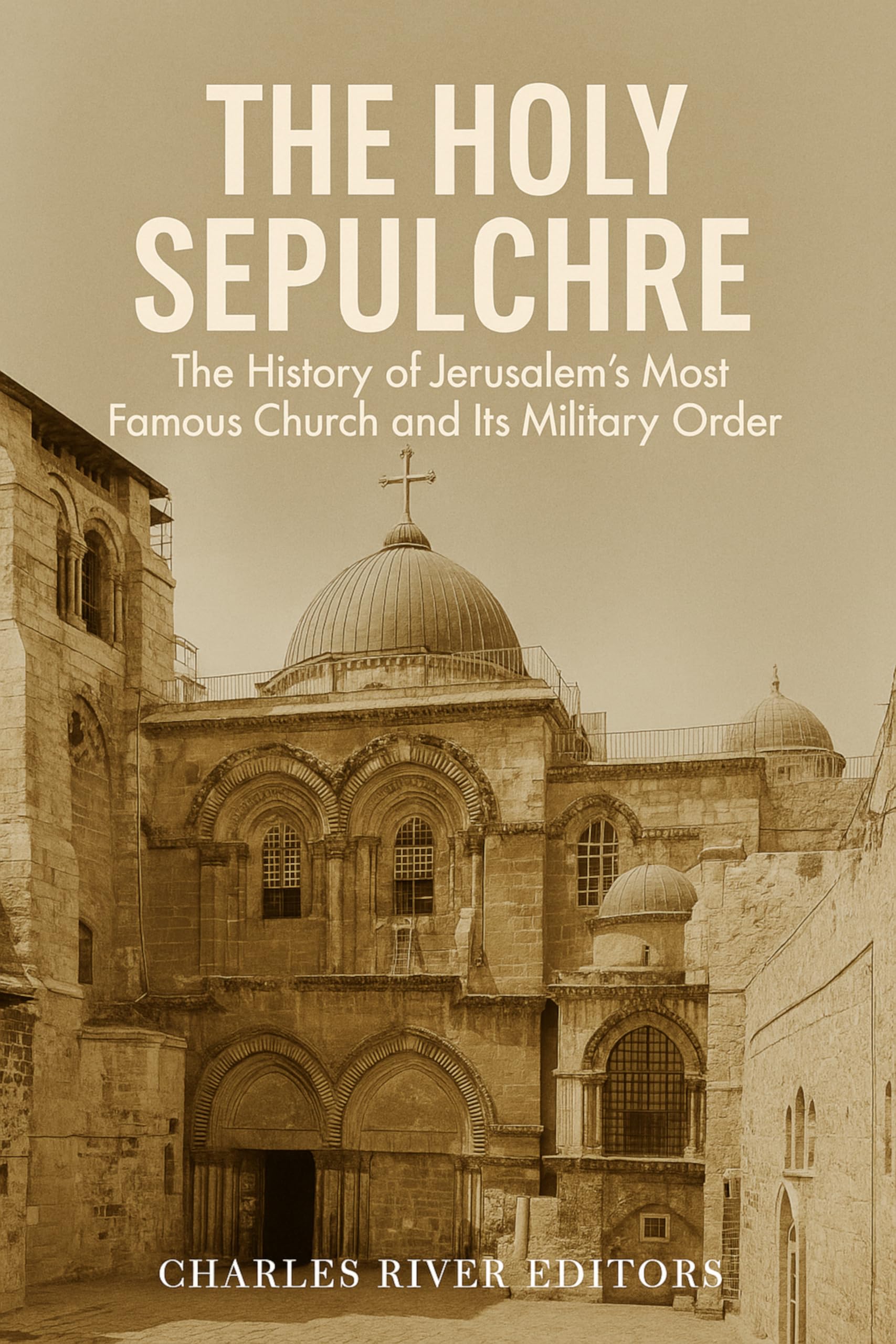
The Holy Sepulchre: the History of Jerusalem’s Most Famous Church and Its Military Order
$0.00$4.99
Explore the rich history of the Church of the Holy Sepulchre, a vital Christian pilgrimage site in Jerusalem, shaped by centuries of conflict and reverence. Discover its profound significance today!