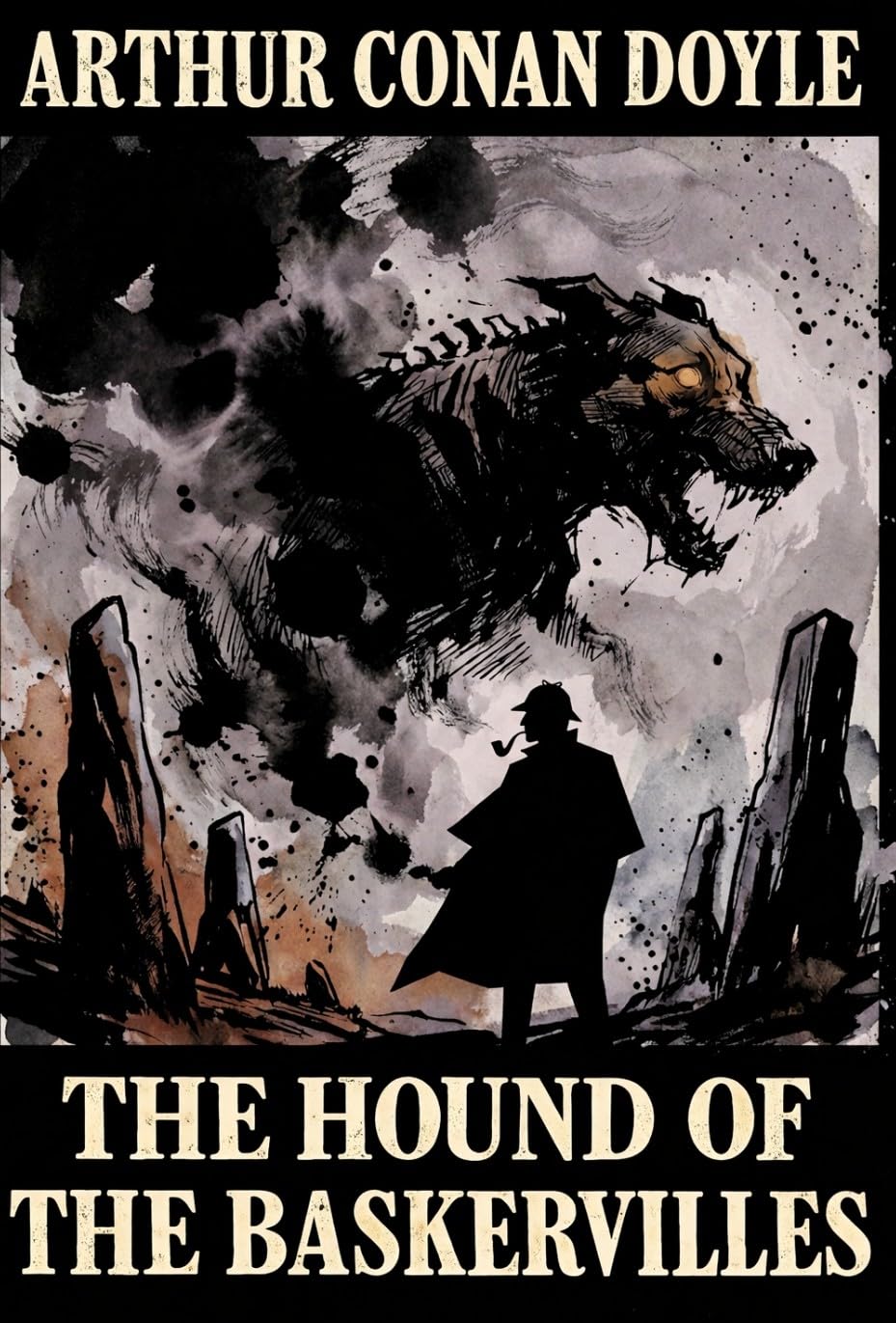
The greatest detective story ever written is also, at its heart, a ghost story that refuses to stop haunting even after the ghost has been explained. This Erato Press critical edition restores The Hound of the Baskervilles to what it has always been beneath the surface: a Gothic novel in disguise.
Before bringing Holmes back from the dead, Conan Doyle found an elegant compromise — a case from the earlier days, set not in the gaslit rationalism of Baker Street but on the vast, fog-shrouded expanse of Dartmoor, where reason itself seems to lose its footing. The result was the finest of the four Holmes novels and one of the most atmospheric works of fiction in the English language: a story in which a spectral hound, a family curse, and an ancient moor conspire to test the limits of rational investigation.
What makes The Hound extraordinary is its refusal to let the rational solution exhaust the mystery. The hound is a trick — a dog painted with phosphorus. But the fear it produces is not a trick. Dartmoor remains, after Holmes has explained everything, vast and indifferent and not entirely comprehensible. The novel holds two incompatible worldviews in suspension until the very end, and the tension between them is never fully resolved. Some things can be both explained and mysterious at the same time.
Sherlock Holmes — absent for most of the novel, a mind made more powerful by its invisibility Dr. Watson — sent alone to Dartmoor, revealing courage and decency that Holmes’s presence usually conceals Sir Henry Baskerville — the last heir, caught between a rational inheritance and an irrational curse Stapleton — patient, charming, obsessive: one of the great villains in detective fiction Dartmoor — not merely a setting but a character, a landscape that erodes certainty itself
✦ The complete, unabridged text of The Hound of the Baskervilles (1902)
This edition also includes: ✦ The Moor and the Mind: Gothic Terror and the Rational Order — a critical essay examining how the novel uses the Gothic tradition to test the limits of Holmes’s rational method, and why the supernatural explanation, even after being disproved, never quite releases its hold ✦ About Arthur Conan Doyle (1859–1930) — a biographical essay tracing the Edinburgh physician who created the world’s most famous detective, grew to resent him, killed him off, and was forced by public demand to bring him back
For readers who enjoy: ✦ The Sherlock Holmes canon and the great tradition of detective fiction ✦ Gothic horror — from Radcliffe and the Brontës to Stoker and Poe ✦ Victorian mystery fiction and the tension between reason and the uncanny ✦ Literary criticism that illuminates rather than obscures
“The hound is real; the curse is not; but the moor remains, at the end, a place where certainty feels unstable.”