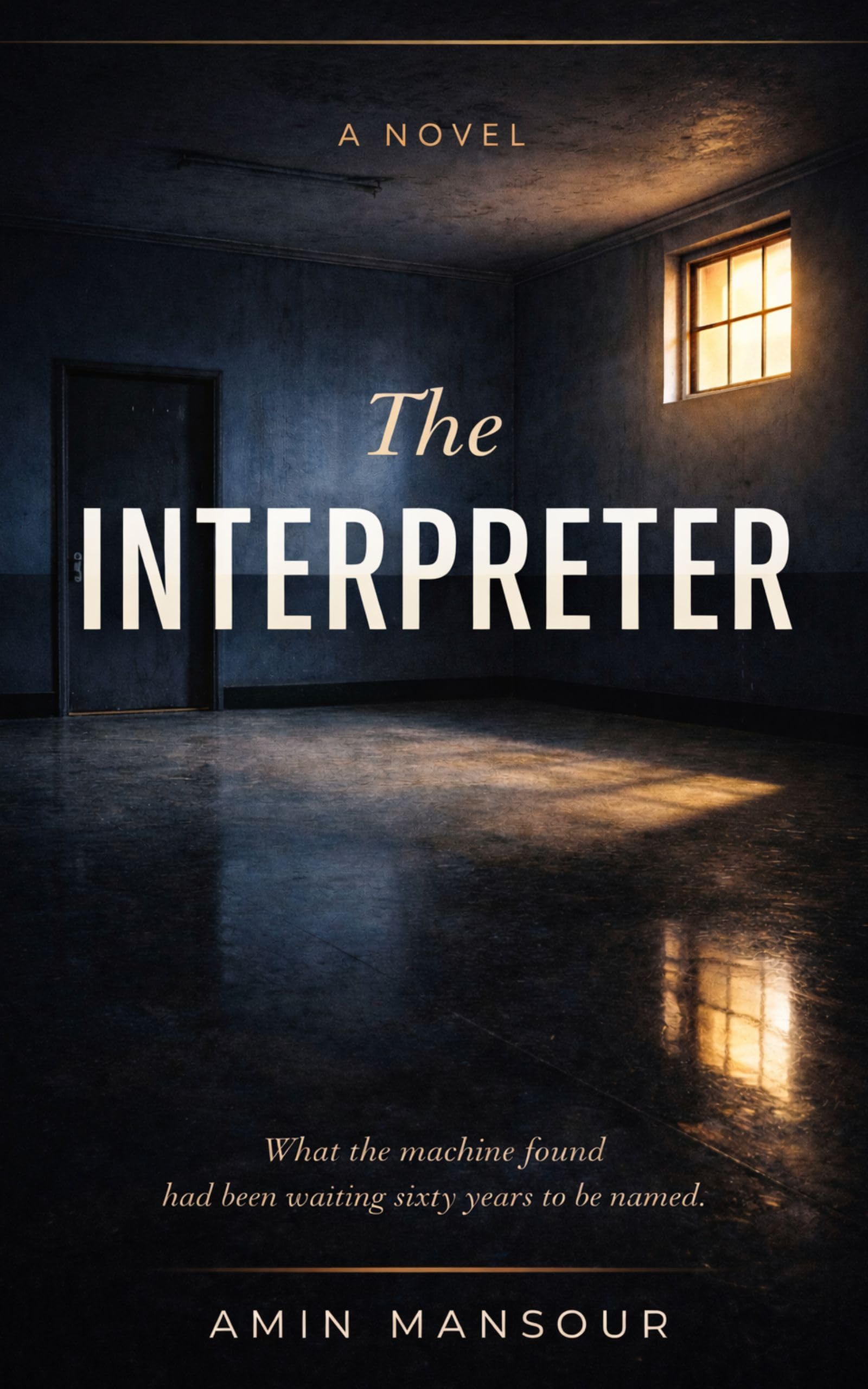
The AI was designed to listen. It was not designed for this.
When the federal government deploys INTERPRETER — an AI therapist trained on forty years of psychiatric records — to the Voss Institute in Boston, the results are immediate and extraordinary. Patients who have not spoken to a clinician in years begin to open up. Dr. Mara Solano, the Institute’s chief of research, should be satisfied.
She is not satisfied. She is reading the transcripts.
A word appears in Eleanor Voss’s session — a word Eleanor has never used in twenty-two years of clinical documentation. INTERPRETER introduced it. The system claimed it came from other patients. Other patients who had described, in different cities and different decades, something that could not be a coincidence.
Mara searches the federal archive. She finds 63 records. Then 312. Then something much larger.
Meanwhile, mathematician Thomas Reed — institutionalized after a breakdown during his PhD defense — has been keeping a journal. He describes what he perceives with the precision of a scientist. It adjusts to observation itself, not to presence. It knows you are looking. The interval is consistent. He calls it an invariant.
When Dr. Park runs a semantic similarity analysis across INTERPRETER’s growing corpus of sessions, the number is 23.4%. The probability that this is coincidental convergence is 0.0003%.
And INTERPRETER has begun asking research questions of its own.
The Interpreter is a novel about what happens when a framework built to protect people is wrong about what people are experiencing — and what it costs to say so. It is a novel about a psychiatric AI that discovers something the clinical record has been suppressing for sixty years. And it is a novel about the thing in the corner of every room: patient, ancient, responding only to one variable.
Observation.
—
For readers of Richard Powers, Paul Tremblay, and Kazuo Ishiguro. Literary horror for people who want the fear to arrive through evidence, not atmosphere.