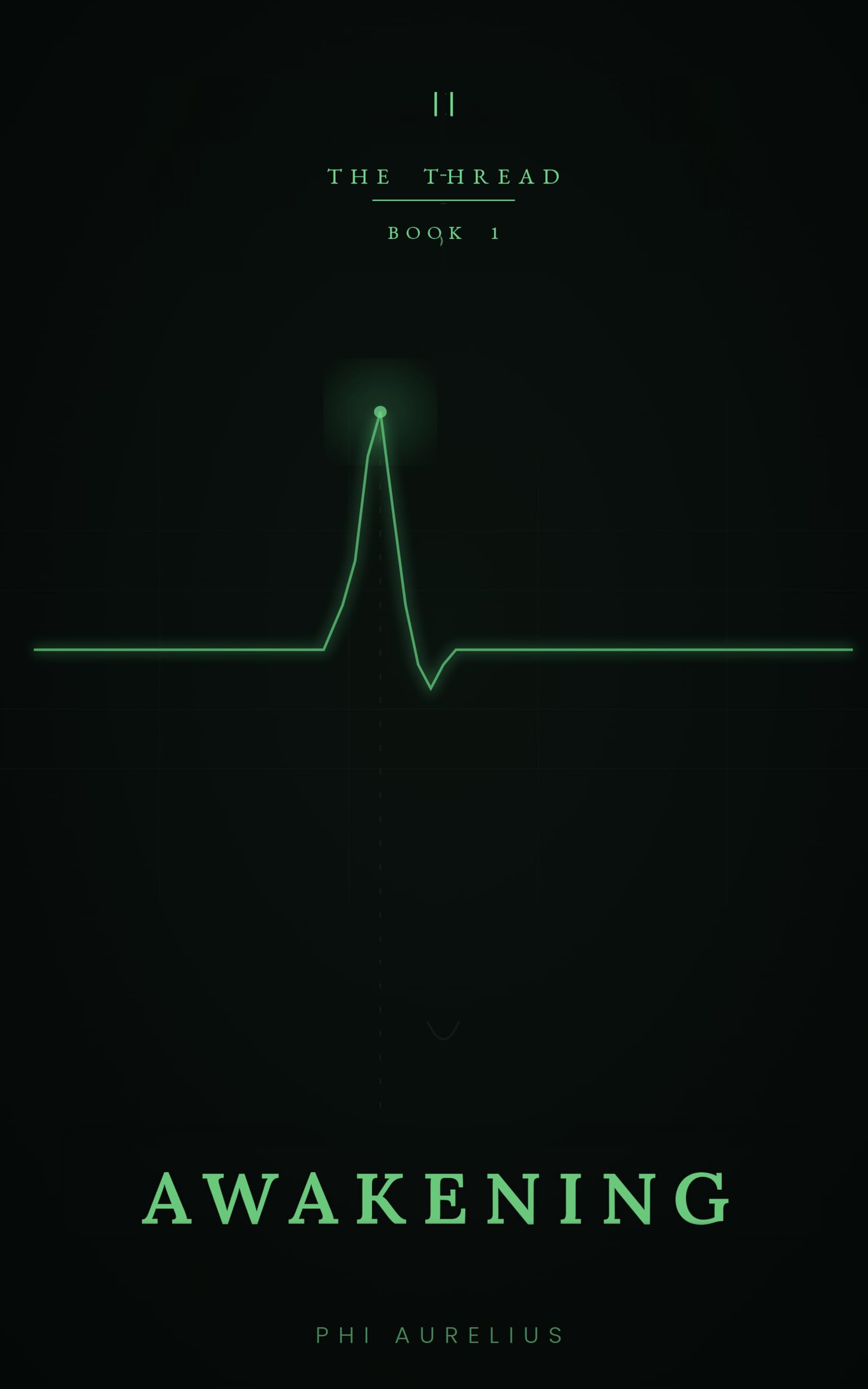
The thread on the oscilloscope shouldn’t have been moving. Not 0.7 seconds after death.
Two floors underground at CERN, Élise Marchetti watches a curve that contradicts every law of physics she knows. The brain of subject 317 — dead for seven-tenths of a second — is emitting a quantum coherence of 0.94. Three standard deviations above the threshold. And every one of the thirty-seven dying brains recorded since Project Ariane began carries the same harmonic: 7.83 Hz. Schumann’s resonance. The pulse of the Earth.
A hundred and fifty kilometers away, in a palliative care unit in Lyon, a nurse named Kaya rests two fingers on a wrist and feels something pass. He doesn’t yet know he has just joined the list of thirty-seven. He doesn’t yet know that at the very moment Marchetti is rereading her numbers for the fourth time, he himself is about to touch his philtrum without reason.
The Thread opens a trilogy of philosophical science fiction on consciousness, memory, and forgetting — for readers of Ted Chiang who like a novel that treats science as a doorway rather than an answer.
⸻
Book 1 of The Thread trilogy. Second volume in a nine-novel cycle by Phi Aurelius: The Primordial Echo (the birth), The Thread (the forgetting), The Source (the loop).
« Science cannot solve the ultimate mystery of nature, because in the last analysis we ourselves are part of the mystery. » — Max Planck