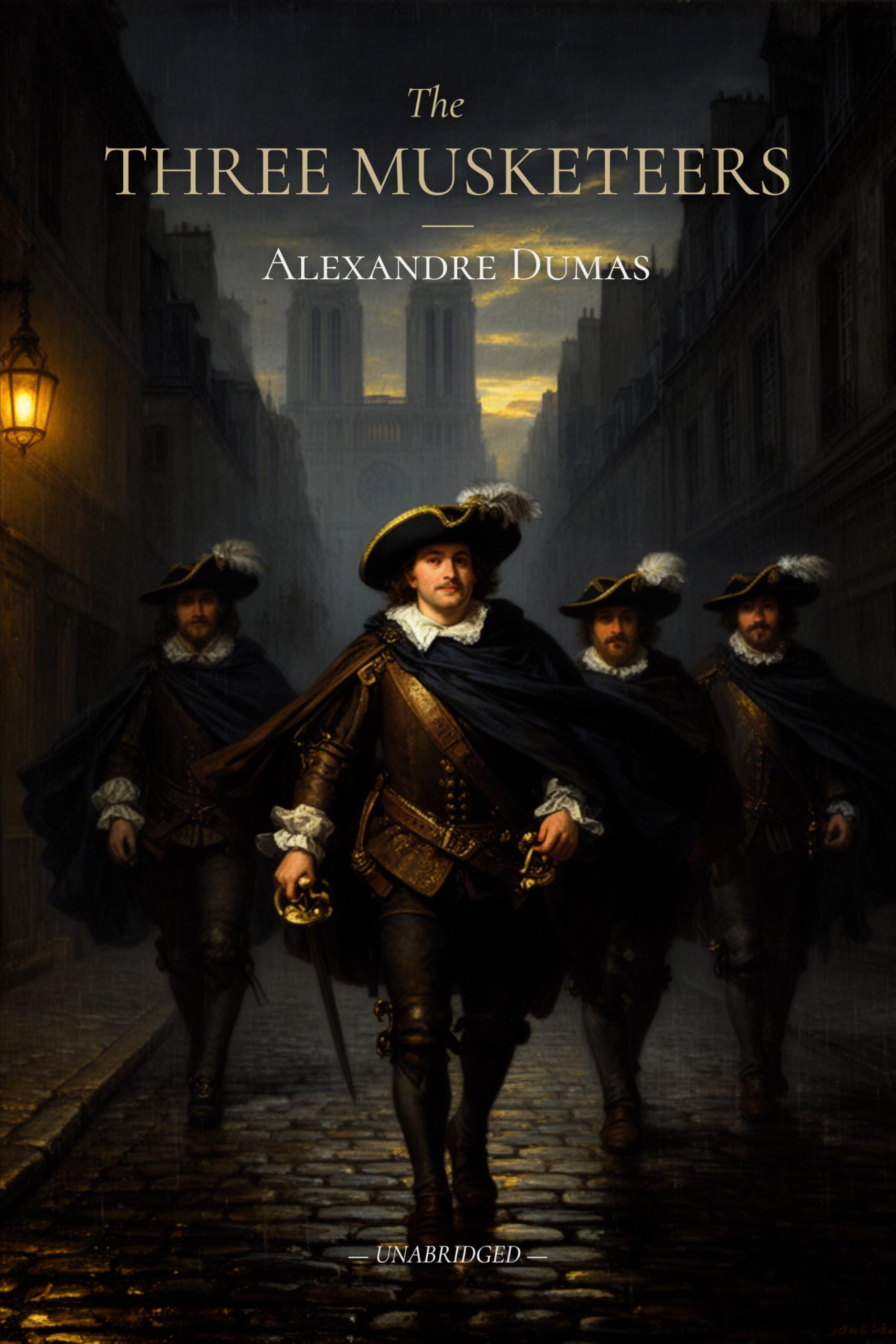
This is not the translation you already know. This is the one Dumas deserved.
In 1844, Alexandre Dumas serialized The Three Musketeers in a Paris newspaper at a pace that left readers sleepless and booksellers helpless. He was writing, he said, not about what happened — but about what could have happened. That distinction explains everything. His seventeenth century is not the historian’s; it is the novelist’s: a century of rapiers and intrigue and absolute loyalty among men who have no reason to trust anyone, and trust each other completely.
The Three Musketeers — D’Artagnan rides out of Gascony with twenty crowns and a horse the color of embarrassment. What follows is Paris: its duels, its conspiracies, its cardinal, its queen, and the most dangerous woman in Europe.
The plot turns on a set of diamond studs, a night in London, and the question of whether loyalty to a friend outweighs loyalty to a king. It moves at the velocity of a blade — and like a blade, it conceals beneath its gleam a weight you only feel when it lands.
✦ Complete and unabridged — all sixty-seven chapters of the original 1844 text, in a new English translation.
This edition also contains:
✦ A Note on the Historical Setting — the real Cardinal Richelieu, the real Duke of Buckingham, and the precise line between what Dumas invented and what history provided ✦ Letter from Alexandre Dumas Fils — written for the posthumous edition: a son’s meditation on a father who asked, at the end, whether anything of him would remain ✦ Preface by Alexandre Dumas — the novelist’s own account of how he found the manuscript that became this story ✦ About the Author — a critical biography of Dumas, from the son of a Napoleonic general and a formerly enslaved Haitian woman to the most widely read French novelist in history
For readers who enjoy:
✦ Alexandre Dumas (The Count of Monte Cristo, Twenty Years After) ✦ Historical adventure fiction with genuine literary weight ✦ Classic European novels in fresh, contemporary translations ✦ Victor Hugo, Robert Louis Stevenson, and the great tradition of plot-as-philosophy
All for one, one for all — a formula so simple it sounds like a joke, until you realize it is the only honest answer to the problem of other people.