
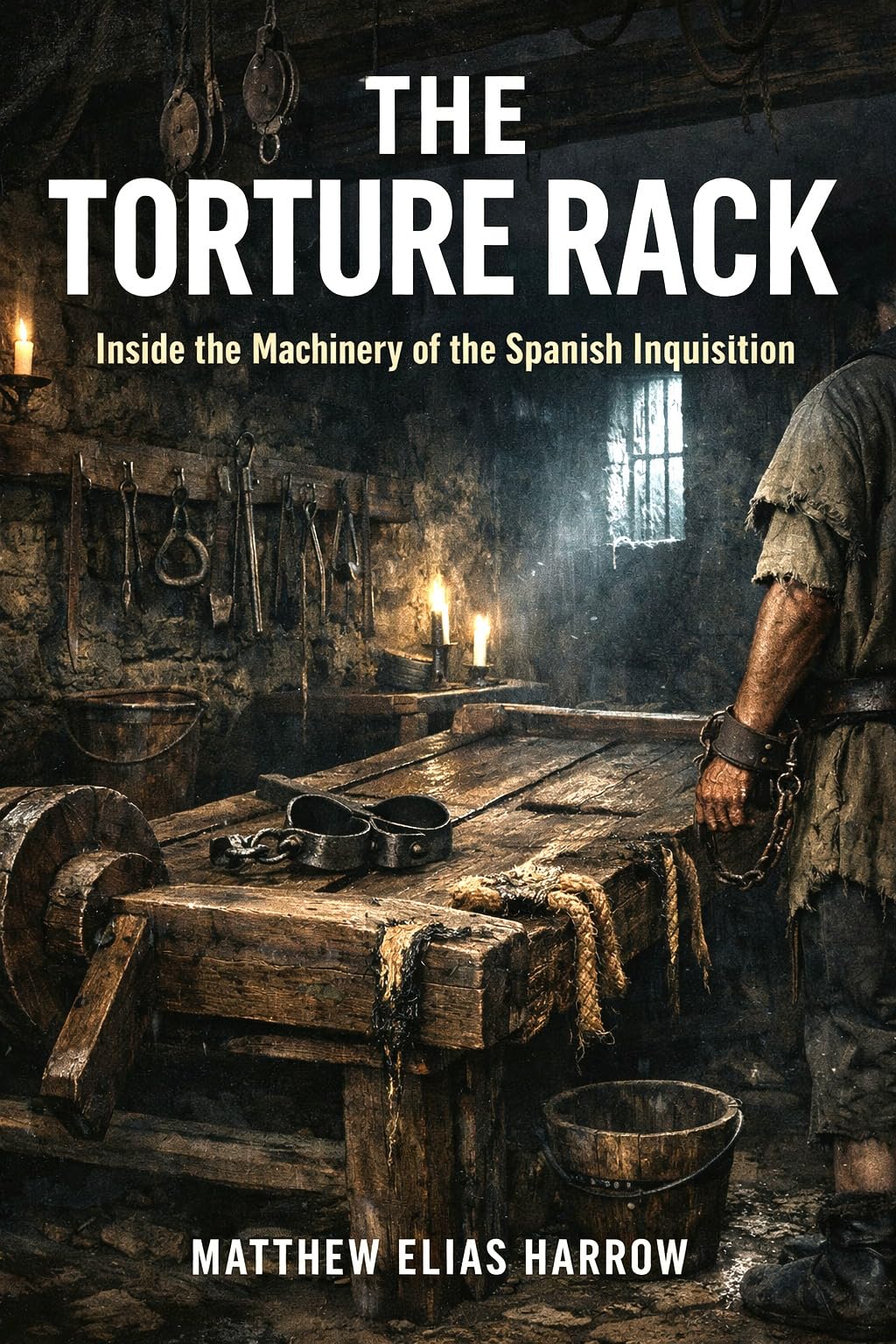
THE TORTURE RACK
Inside the Machinery of the Spanish Inquisition
For centuries the Spanish Inquisition has lived in the public imagination as a nightmare of theatrical cruelty—dungeons lit by roaring torches, sadistic priests, and elaborate machines built purely for suffering.
But the real torture chambers were nothing like the legend.
They were smaller. Quieter. More bureaucratic.
Inside those stone rooms, guards argued about worn ropes. Assistants repaired cracked wooden racks. Clerks sat at candlelit desks recording every word of interrogation while screams echoed against damp walls.
The horror of the Inquisition was not theatrical evil.
It was routine.
In The Torture Rack, historian Matthew Elias Harrow dismantles centuries of myth and exposes the mundane machinery behind one of history’s most feared institutions. Using the investigative framework The Rack Mechanism Deconstruction Protocol™, this book takes readers step by step through the reality of the interrogation chamber:
• The architecture of the rooms where confessions were extracted
• The crude tools forged by local blacksmiths and carpenters
• The pulley systems and ropes that turned gravity into torture
• The scribes who documented every denial and confession
• The maintenance routines that kept the chamber functioning
• The myths later invented by novels, films, and sensational history
What emerges is not a gothic spectacle but something far more disturbing.
The Spanish Inquisition functioned as a bureaucratic machine of suffering, sustained not by monsters but by ordinary people performing ordinary tasks inside a system designed to break human bodies and produce confessions.
Grim, immersive, and deeply researched, The Torture Rack strips away the legends to reveal the unsettling truth behind the Inquisition’s most infamous room.
History’s darkest institutions were not built on spectacle.
They were built on procedure.
Editorial Reviews“A chilling demolition of centuries of myth.” Matthew Elias Harrow strips the Spanish Inquisition down to its mechanical parts. The result is far more disturbing than the familiar gothic legends. This book reveals how bureaucratic systems can turn cruelty into routine labor. — Dr. Pedro Gutierrez, European Religious History Review
“Dark, immersive, and brutally honest history.” Harrow’s writing places you inside the interrogation chamber—the damp stone, the scorched rope, the scratch of a quill recording every word. It reads like historical noir while remaining deeply grounded in archival reality. — Historical Narrative Quarterly
“One of the most unsettling history books I’ve read.” Not because it’s sensational, but because it shows how ordinary people kept the machinery of torture running through routine work. A powerful reminder that institutions can normalize cruelty. — The Chronicle of Dark History


