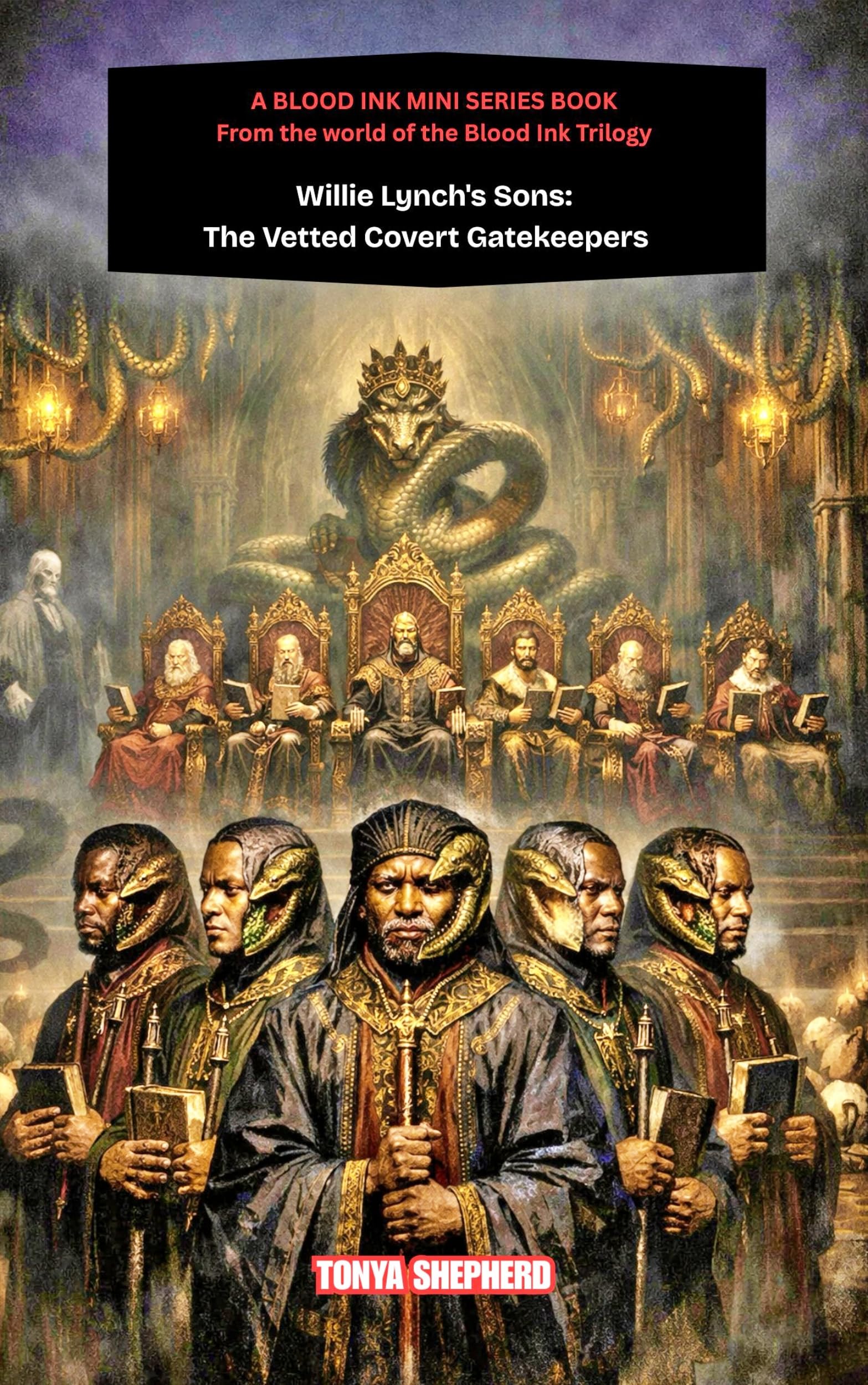
Content Warning: This book contains mature themes, including discussions of historical and systemic racial violence and psychological trauma. It is intended for a mature audience committed to engaging with difficult, critical conversations about power, culture, and identity.
In Willie Lynch’s Sons: The Vetted Covert Gatekeepers, I examine how the brutal logic outlined in the infamous “Willie Lynch Letter”—designed to break and control an enslaved population—did not die with emancipation. It evolved. Today, it wears a suit, holds a degree, and walks among us.
Part 1 revisits the Lynch thesis alongside the 2003 Ashcroft Memo, which gutted judicial discretion and expanded the carceral state—an updated method of control.
Part 2, “Leased Loyalty,” dissects professional sports as a contemporary “plantation,” where Black male bodies are commodified and discarded.
Part 3 explores how “lynching” has been abstracted from its specific horror into a metaphor for any public crucible.
Part 4, “Romantic Espionage,” examines intimacy weaponized. Part 5 analyzes the “Irony of Imperial Justice” through Diddy and Diageo, revealing corporate power and the legal system as a continuum of control.
Part 6: “The Double Yoke: The Decrowned Gatekeeper” forms the heart of the book. We trace the historical “decrowning” of the Black man that birthed the “Driver” archetype, who re-emerges today as the “Vetted Covert Gatekeeper.” This section dissects how credentialism has become a new pigment, a crown that is actually a collar. We explore the archetypes he inhabits—the Driver, the Token, the Traitor—and confront the covert violence of a brother’s hand carrying the master’s memory, the generational curse of father-son betrayals, and the “Digital Overseer” forcing performances of success.
Part 7 explores the intersection of faith and violence. Part 8 examines the “Divine Nine” as a potential “Symphony of Vetted Covert Gatekeepers,” perpetuating hierarchies they were created to overcome.
Willie Lynch’s Sons is a call to recognize how we are divided and gatekept—not always by an external enemy, but sometimes by a reflection in the mirror.