During the first half of the 1st millennium A.D., an empire arose in Persia that extended its power and influence to Mesopotamia in the east, Arabia in the south, the Caucasus Mountains in the north, and as far east as India. This empire, known alternatively as the Sasanian Empire or Sassanid Empire, was the last of three great dynasties in Persia—the Achaemenid and the Parthian being the first two dynasties—before the rise of Islam. In fact, many scholars consider the Sasanian Empire to be the last great empire of the ancient Near East because once it had been obliterated, Islam became the standard religion of the region, ushering in the Middle Ages.The Sasanian Empire was important for a number of reasons. Besides being the last of three great Persian dynasties, they carried on many Persian cultural traditions relating to religion and kingship. The Sasanians fostered and promoted the native religion of Zoroastrianism to the point of persecuting other religions from time to time. It was during the Sasanian period that the numerous Zoroastrian hymns, prayers, and rituals were collected under one book, known as the Avesta.Thanks to the Sasanians’ efforts with regard to religion, modern scholars know much more about Zoroastrianism than they would have if the religion continued to disseminate orally. Their efforts also protected Zoroastrian knowledge in later years after the dynasty was long gone and Islam became ascendant in Persia. Moreover, the Sasanians’ spread into India meant that there were syncretic developments between Zoroastrianism and Indian mythology and religious practices, including not just Hinduism but also Sikhism, Jainism, and Buddhism. The diverse traditions and ethnic groups that have called India home over the past 5,000 years combined to create a mythology that is as eclectic as it is interesting. As a result, Zoroastrianism is technically still a living religion today, but the religion is mysterious and not widely known among those who don’t study it, and historians themselves are divided over when the religion’s prophet lived and when the religion was officially adopted in Persia.In the early years of the Roman Empire, as Christianity struggled to gain a foothold and survive in the polytheistic pool of Roman theology, its greatest rivals weren’t the Caesars or the Roman aristocracy but rather the faith and devotion of the common Roman legionaries. The faith of these men was centered on the god Mithras, who, they believed, led them to victory upon the field of battle and had done so for nearly four centuries.Despite this widespread belief among soldiers, the cult of Mithras was not a creation of the Romans, although they would eventually add their own rituals and mysteries to the ancient religion. In fact, the Mithraic religion was an Indo-Persian creation, a theology which managed to travel from India and back into the Hellenic and Roman world by way of Alexander the Great’s conquest of the Persian Empire. Eventually, the cult of Mithras would spread across the ancient world, and Mithras would be worshiped from the mountains of India to the coasts of Spain. As a result, the cult of Mithras could ultimately be found in every corner of the Roman Empire.The Mithras cult was one of the many “mystery religions” that the Romans adopted, several of which came from cultures outside of Rome. Isis, an Egyptian goddess, and Cybele, an Anatolian goddess, were both popular with Roman women, while Mithras, which was a variation of the name of the Zoroastrian demigod Mithra, was popular with Roman soldiers and the political elite for over 400 years. Since the Mithras cult, like all of the Roman mystery cults, was esoteric in nature, the exact nature of the influence other cultures had on the cult remains unknown, but some archaeological evidence has led modern scholars to make educated deductions.
save
$5.99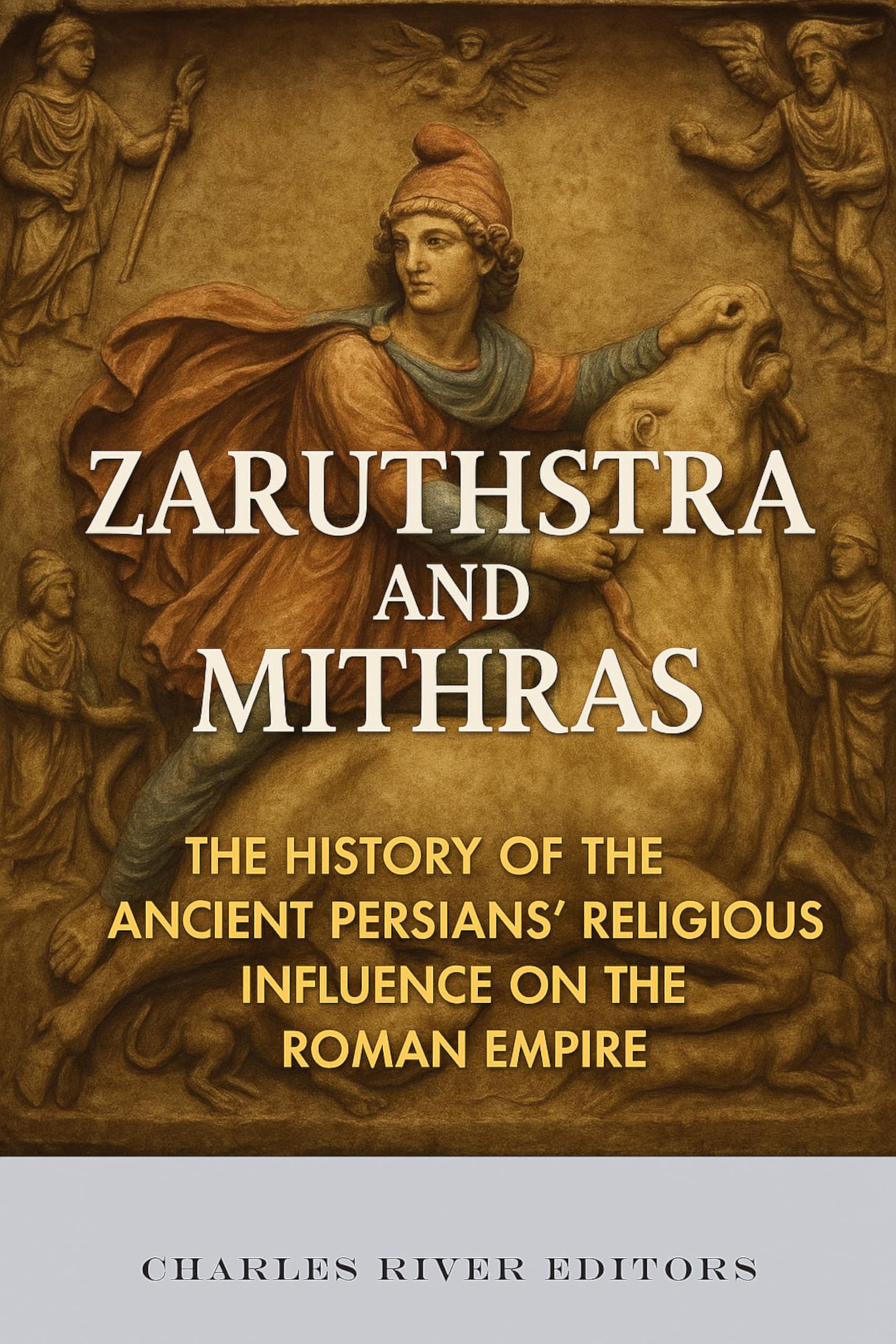
Zaruthstra and Mithras: the History of the Ancient Persians’ Religious Influence on the Roman Empire
$0.00$5.99
Explore the fascinating rise and fall of the Sasanian Empire, its role in preserving Zoroastrianism, and the spread of the Mithras cult within the ancient world.