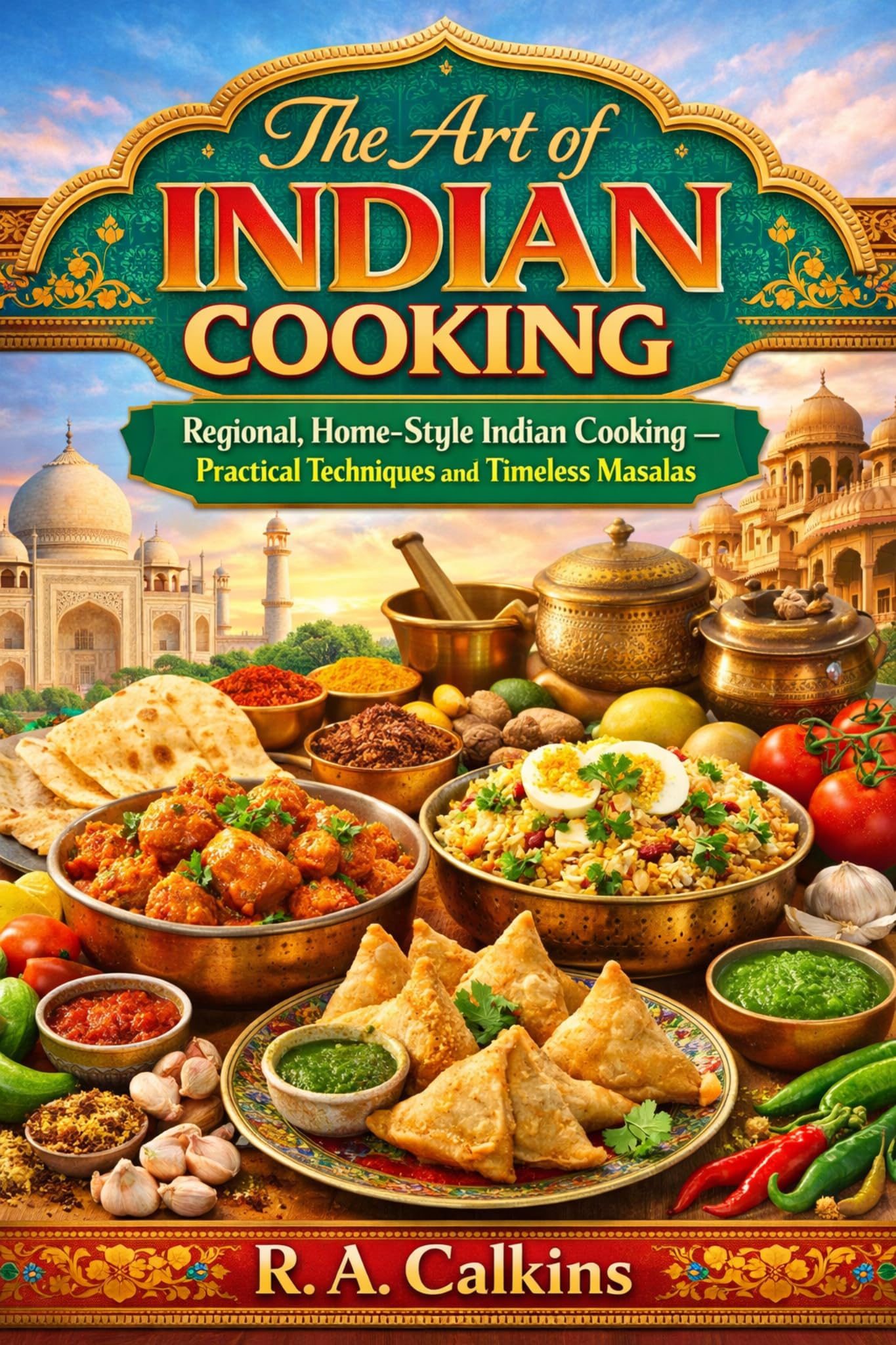
The Art of Indian Cooking teaches home cooks how to make regional, home-style Indian food that tastes like a household, not a restaurant. R. A. Calkins strips away mystique and replaces it with clear, repeatable practices: how to build flavor in layers, when to temper spices, how to toast and grind masalas, and how to balance salt, heat, acid, and fat so each dish arrives with clarity and purpose. This book is a practical curriculum for everyday kitchens, written so you can read a recipe with confidence and improvise when a spice or ingredient is missing.
Calkins begins with foundation work: the three guiding principles of Indian cooking — layering, tempering, and balance — and a modest, realistic pantry that will carry you farther than a shelf of obscure jars. You’ll learn the minimal tools that matter (a heavy-bottomed pan, a tava, a mortar or grinder, and a small skillet for tempering) and small, repeatable techniques that become kitchen muscle memory: slow-browning onions for body, tempering to perfume dals, emulsifying yogurt so sauces stay silky, and cooking lentils to the right texture.
A major section of the book is devoted to masala as method: how to toast whole spices, cool and grind them, and store blends so they are bright and useful. Practical one-page masalas — a house garam masala, a day-to-day curry masala, and a toasted cumin finish — are ready to print and use. Each masala is accompanied by rules for blooming spices in fat, and by simple, serviceable variations to help you scale or adapt to what your market offers.
Recipes emphasize technique and flexibility. Start with a basic tadka and dal, a well-executed basmati rice, a dry vegetable curry, and reliable flatbreads. From there the book offers variations and finishing moves — a squeeze of lemon, a pinch of jaggery, a last-minute herb finish — that lift ordinary ingredients into generous meals. Regional notes explain why mustard oil or coconut milk matters in certain places and when honest substitutions are acceptable without pretending the dish is unchanged.
Above all, this is a book about hospitality and stewardship of flavor. Calkins invites patient practice rather than frantic experimentation: learn the small arts, repeat them, and your pantry and season will be the real teachers. If you want Indian food you can make in an ordinary kitchen — honest, teachable, and full of heart — this book hands you the skills, the masalas, and the recipes to do it with confidence.