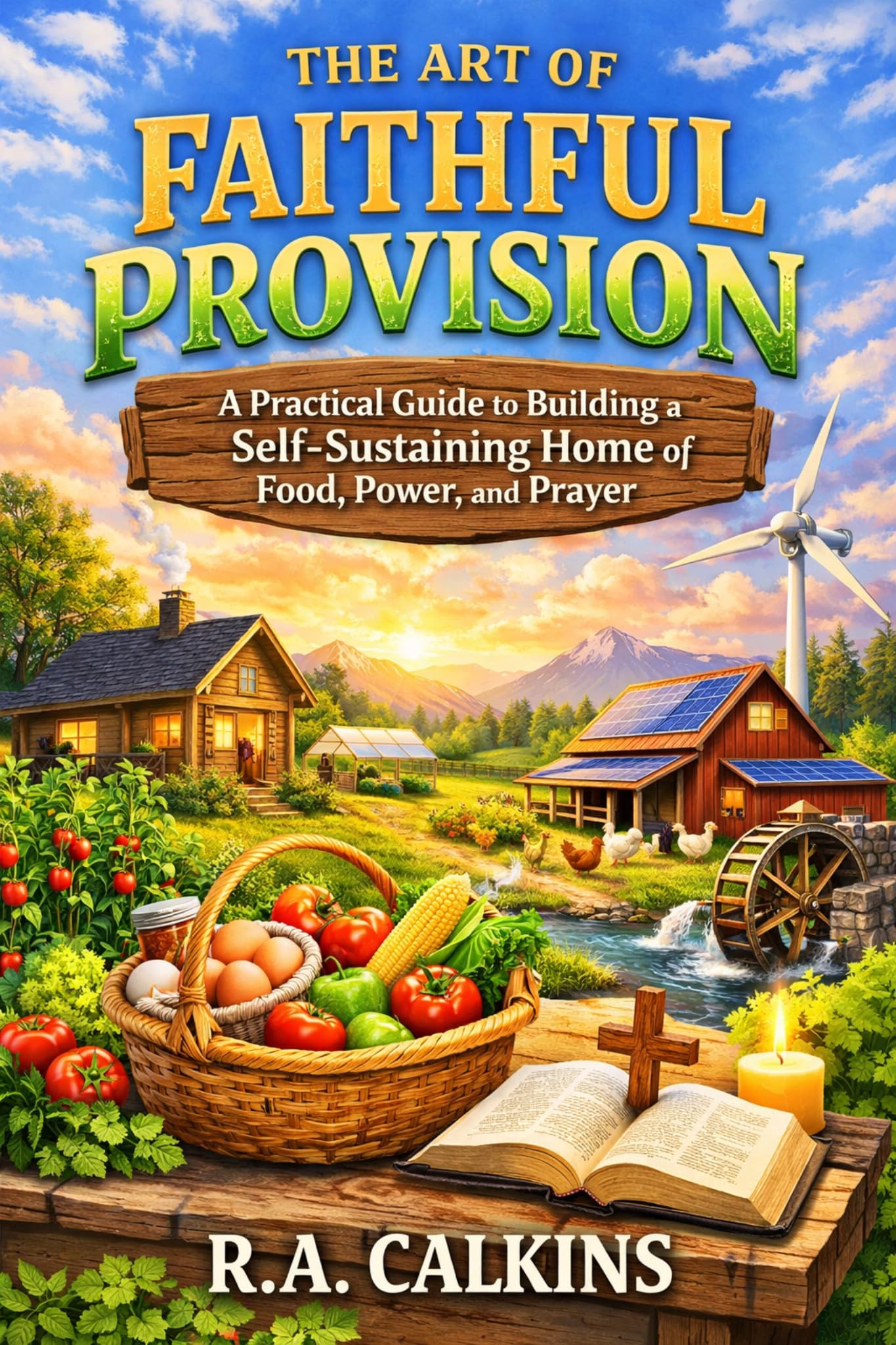
The Art of Faithful Provision: A Practical Guide to Building a Self-Sustaining Home of Food, Power, and Prayer invites the reader to treat provision as a matter of worship and stewardship rather than a hobby or panic plan. Rooted in a Christian theology of tending what God entrusts—land, hands, time, and neighbors—this book gives exact, repeatable numbers, simple rules, and low-risk systems so a household can feed, water, and power itself without surrendering the central life of prayer. You will find a theology that steadies your heart and a workshop that steadies your pantry.
This is a hands-on manual with both conservative planning anchors and day-to-day rhythms. Begin with measurable baselines: a one-year family pantry built around grains, legumes, and fats; water targets that combine stored reserves and catchment; and modest, resilient off-grid power sizing that starts with a 2 kW PV array and a battery bank sized for one day of autonomy. The text converts calories into realistic weights and shows how a family of four can plan for a year of staples, how to translate calories into acreage when you want to grow your backbone crops, and how to prioritize water, food, and power when resources are limited.
Where many preparedness books stop at lists, this one treats the pantry as a workshop. You will learn pantry architecture—working pantry versus bulk reserve—packing workflows that produce reliable Mylar-and-bucket modules, conservative oxygen-absorber math, sensible rotation and inspection habits, and a sealing workflow you can teach in minutes. Detailed, reproducible systems cover preserving, root cellars, dehydration, canning, and cold storage options tied to modest power solutions. The aim is durable, usable food, not kits that fail when conditions are imperfect.
Practical engineering meets practical economics and common sense: buy the right materials, cost out a DIY bucket kit, size a generator for essential loads, and plan for safe fuel rotation. The book gives conservative solar and battery rules of thumb, simple wiring and inverter considerations, and sensible land estimates for producing staple calories in small acreage. It also covers essential non-technical systems—inventory templates, batch workflows, labeling, and a one-page SOP to keep your workshop predictable and repeatable.
This is not a manual for fear; it is a handbook for humility and faithful work. The disciplines of inventory, weekly baking from stored grain, maintaining a generator, and tending a berry patch become spiritual practices when done with thanksgiving and dependence. The final sections offer checklists, inspection forms, seed priorities, and short weekly and annual rhythms that tie practical labor to prayerful stewardship. If you want a sober, skillful, and faith-shaped approach to making your household resilient—one that trades alarm for craftsmanship—this book gives the numbers, the systems, and the heart to begin.