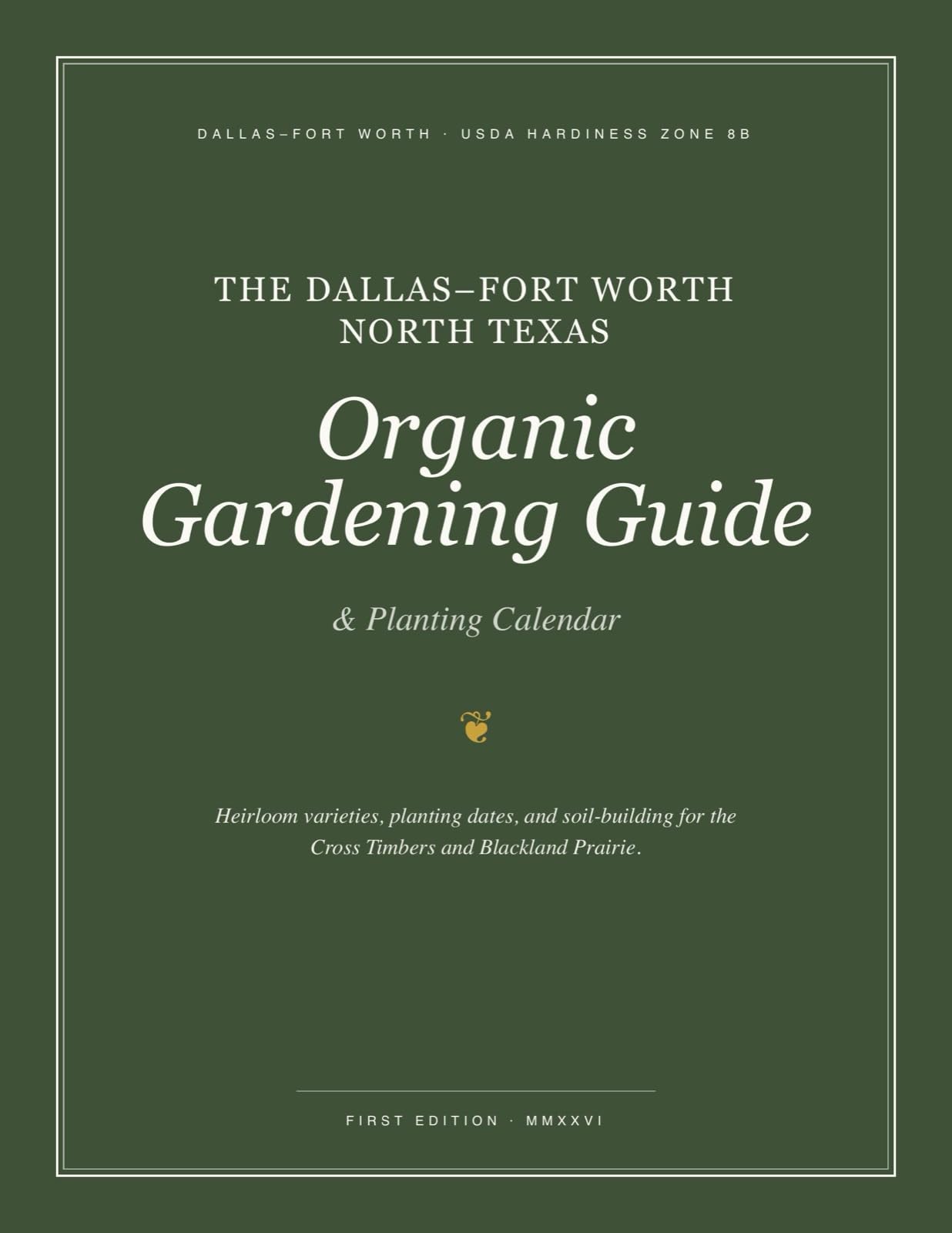
An organic gardening reference written for North Texas.
Most gardening references are written for somewhere that isn’t Dallas-Fort Worth. The catalogs assume cooler summers, the YouTube channels are filming in Oregon, and “amend with sand” is bad advice on Blackland clay. Tomatoes that thrive in zone 6 set no fruit through a DFW July. Apples that need 800 chill hours don’t get them here.
This book is the regional fix. There are 446 pages covering what actually grows in North Texas, when to plant it, and how to build soil that supports it without synthetic inputs.
What’s in it
A planting calendar built on local frost dates (last frost mid-March, first frost around November 22) and 4-inch soil temperatures, not generic zone math.
Around 150 crop entries with cultivar-level recommendations: warm and cool season vegetables, herbs, berries, fruit and nut trees, vines, companion flowers, natives, cover crops, and ground covers. Each entry says which varieties hold up here and which don’t.
Soil-building for Blackland Prairie clay (pH 7.5–8.2, calcareous) and Cross Timbers sandy loam (pH 6.0–7.5). Why gypsum is useless on calcareous soil, why sand-into-clay forms concrete, and what extension research actually supports instead.
Seed starting, hot and cold composting, vermicomposting, and herbicide-carryover testing for compost and straw.
Less-common techniques that fit the climate: ollas, hügelkultur, biochar, in-ground worm towers, and animal manure NPK with rates and salt-burn warnings.
How it’s sourced
Every factual claim cites a source. Texas A&M AgriLife Extension first, then other land-grant extension services, then peer-reviewed research. No vendor recommendations, no synthetic fertilizer programs, no pesticide branding.
Region
USDA zone 8b. Tarrant, Dallas, Collin, Denton, Johnson, Parker, Ellis, Kaufman, Rockwall, Hood, and the surrounding North Texas counties. Roughly 255 frost-free days. Pest pressure includes squash vine borer, Pierce’s disease, and fire ants, all addressed entry by entry.