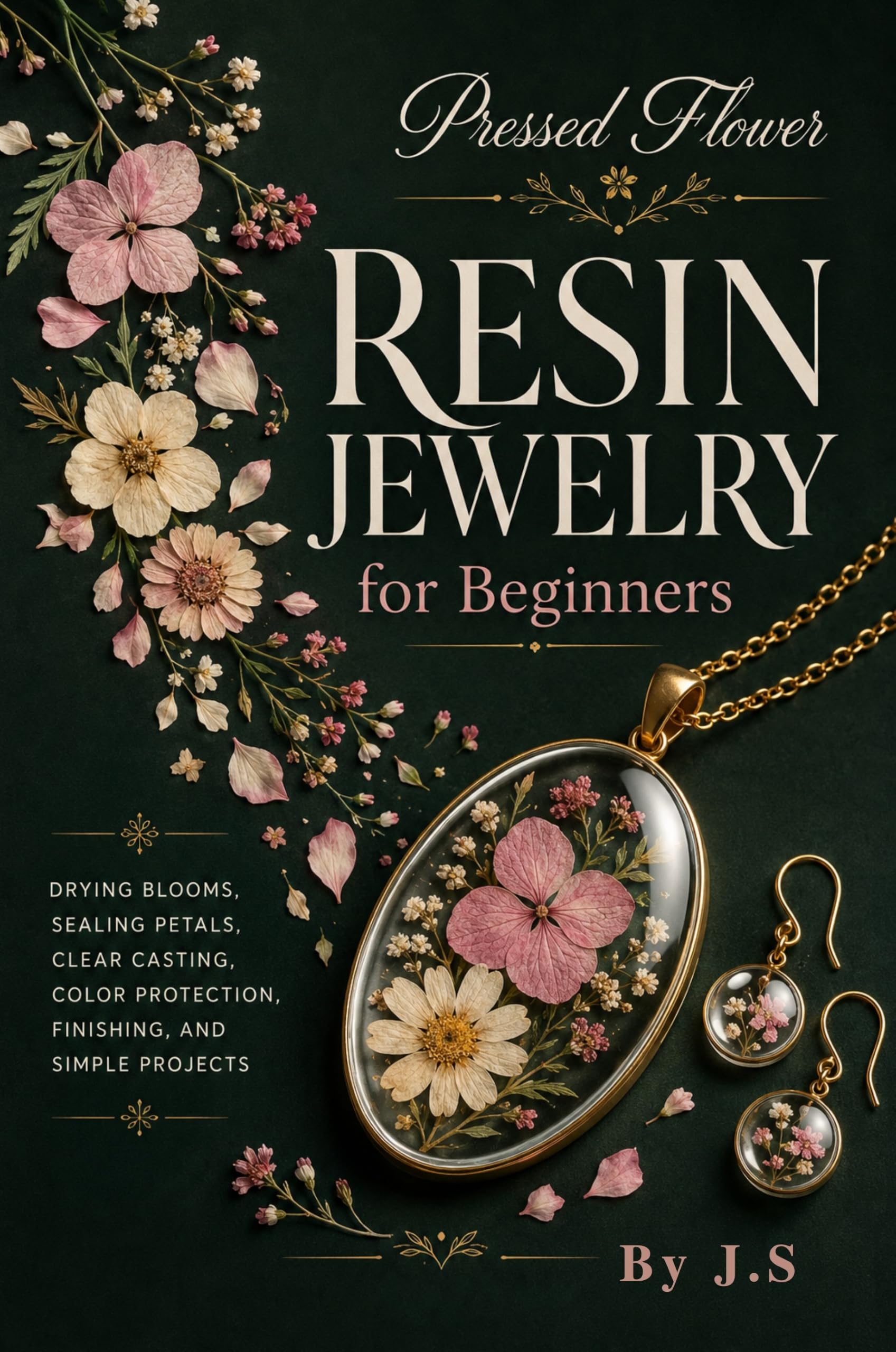
Turn real flowers into wearable resin jewelry without relying on guesswork once the mixing begins.
Pressed flowers can look perfect on the table and behave very differently inside resin. Petals may darken, float, curl, release bubbles, become transparent, or shift just as the design starts to look right. Bezels can leak, layers can turn cloudy, and domes can overflow with one enthusiastic final drop.
Pressed Flower Resin Jewelry for Beginners gives you a clear path from choosing a bloom to assembling and caring for the finished piece. Written for complete beginners, it explains what to do, what to watch for, what commonly goes wrong, and when a project should be corrected, restarted, or left alone.
You will learn how to:
• Choose flowers, leaves, and stems for small jewelry designs
• Dry blooms while protecting shape and color
• Decide when sealing is useful
• Measure and mix resin carefully
• Reduce bubbles and flower movement
• Cast with silicone molds and bezels
• Build clean layers and smooth domes
• Sand, drill, polish, and attach findings
• Diagnose sticky resin, cloudiness, cracks, and loose hardware
• Clean and store finished jewelry properly
Learn the complete process not just a collection of projects.
This guide focuses on the practical decisions behind a clean, wearable result: whether a flower is dry enough, how it should face inside a mold, where bubbles hide, when another layer may be added, and whether an attachment point is strong enough to use.
The instructions are written to be followed clearly without relying on pictures. Flower position, resin behavior, warning signs, and expected results are explained in plain language. Manufacturer instructions still come first for ratios, pour depths, cure periods, ventilation, protective equipment, and material compatibility.
Practice with approachable jewelry projects.
Apply the techniques through a clear flower pendant, coordinated earrings, pressed-petal studs, a botanical ring, an open-bezel pendant, a layered charm, a bracelet charm, and a botanical bag charm.
Each project develops a useful skill, including dry fitting, staged casting, pair matching, bezel sealing, layering, hardware placement, and final inspection.
Know what can be fixed-and what should not be worn.
The troubleshooting section helps you identify likely causes instead of covering every problem with another coat of resin. Learn how to assess bubbles, brown or transparent petals, color bleeding, tilted casts, underfilling, dull surfaces, dome defects, crooked holes, opening jump rings, and loose posts or bails.
You will also learn the difference between a cosmetic imperfection and a structural problem. A tiny internal bubble may be acceptable. Persistent softness, spreading cracks, exposed flowers, separated layers, or weak attachment points require a different decision.
This guide is well suited to:
• Adults beginning resin jewelry making
• Pressed-flower crafters exploring wearable projects
• Hobbyists using dried flowers, molds, and bezels
• Makers who want clearer troubleshooting and finishing guidance
• Anyone preserving garden blooms or meaningful flowers through craft
You do not need an elaborate studio or a huge supply collection. Begin with a small design, compatible materials, careful preparation, and enough patience to let each stage finish properly.
Start with one flower, one simple project, and a process you can repeat.
With thoughtful preparation and steady practice, you can move from loose dried blooms to pendants, earrings, rings, and charms that look intentional from flower placement to final assembly.