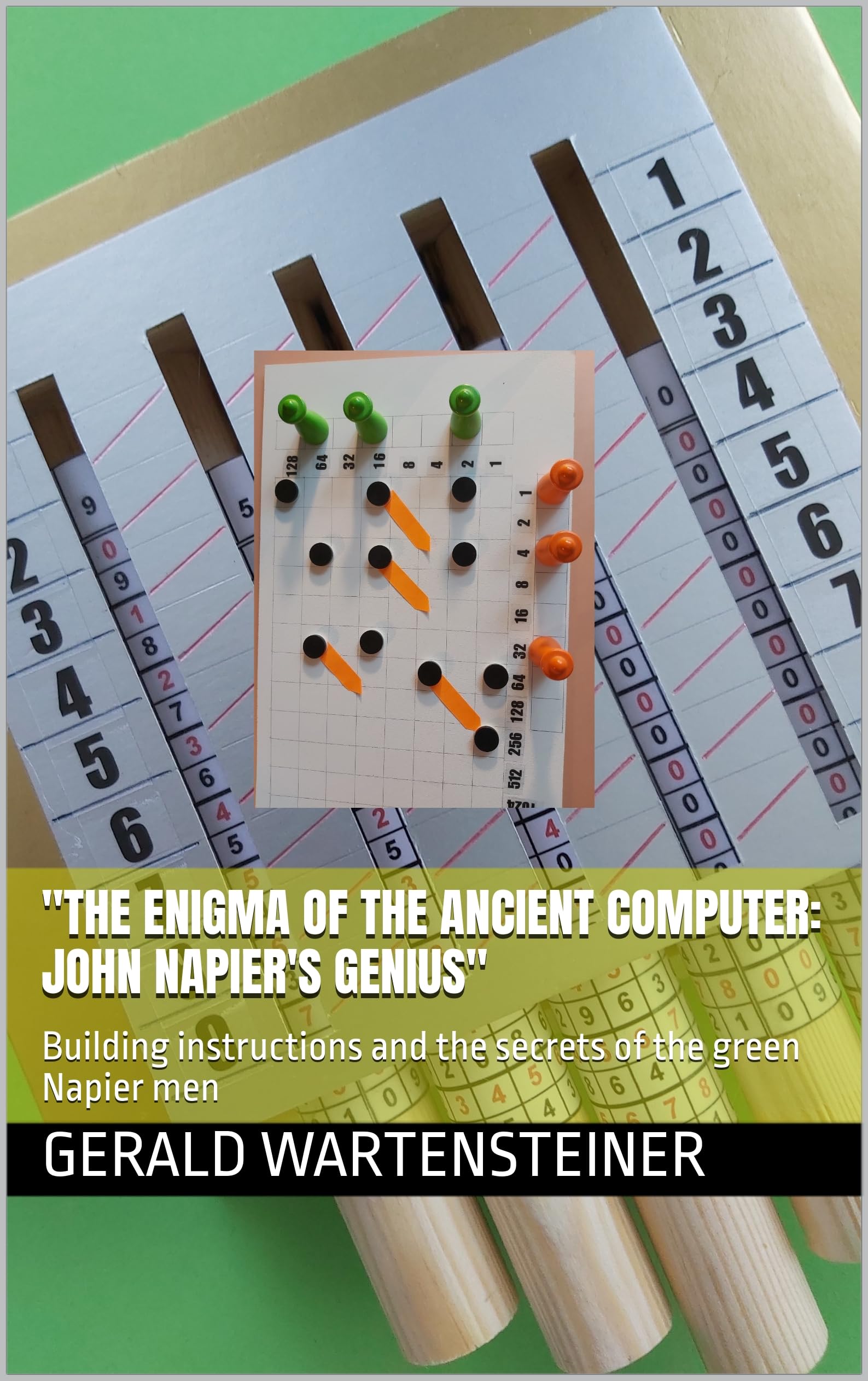
Introduction: John Napier’s ingenious “antique computer”
Immerse yourself in a mysterious journey back to the 16th century. Back then, an extraordinary man named John Napier, known as the Lord of Merchiston, lived in Scotland. Born in 1550 and died in 1617, Napier was a brilliant theologian and mathematician who was far ahead of his time. His groundbreaking mathematical findings, including the invention of the logarithm, are still of great importance today. But Napier left behind much more than just this famous discovery.
Did you know that he also developed fascinating mechanical calculating aids? His so-called calculating sticks and the mysterious “Promptuary” have fallen into oblivion. What is behind these ancient devices and how could they enhance our understanding of early maths and technology?
The rake box – historical and mysterious
Based on Napier’s inventions, Caspar Schott built a calculating box before 1680, which was used in Britain as a tide calculator to calculate the ebb and flow of the tide. This historical device harbours many secrets and allows us to marvel at how complex calculations were carried out in a time without modern technology.
Like every computer, our “anticomputer”, which works according to Napier’s principle, also needs an operating system.
But don’t worry, there’s no blue screen of death here! For our antique wonder box, we have created a very special “operating window” with impressive external dimensions of 15 x 4 cm and no less impressive internal dimensions of 11.5 x 1 cm.
By skilful manual operation – yes, you are the processor here – we move this window line by line on our historical calculation miracle. The relevant figures then appear in the window as if by magic. On the following pages, you will find out how these figures are then processed by the input calculation rolls – excitement guaranteed!
Replica – A great experiment!
The author of this book has set himself the task of recreating such a calculator box using simple means and his own creativity. But this is more than just a DIY project – it is a journey into the world of early engineering. The instructions guide you step by step through the construction process. Don’t worry, you don’t have to be a trained precision engineer! With everyday materials and easy-to-follow instructions, you can easily make this historical device yourself. How does the calculator box work and what fascinating calculations can it be used for? That remains a secret for the time being. Let yourself be surprised and discover the hidden possibilities of this ancient technology.
Even those who do not want to build the ancient calculator can gain valuable insights by reading this book. It opens up fascinating perspectives on the history of mathematics and the development of early computing technology.
The game of John Napier
And what are the green Napier men? Yes, you can create a fascinating game with them! Don’t worry, it’s not about aliens. In this clever game, you compete against your opponent – who is faster, who thinks sharper?
The bowerbird and Pascal’s bet
Discover the mysterious chapter about the bowerbird, a master of nature who seems to defy even the laws of physics with his unique courtship behaviour. His extraordinary display to win the heart of his mate will amaze you.
At the end, you can expect an intellectual journey into the depths of philosophy: Blaise Pascal’s famous wager. A wager that raises the biggest questions of mankind – is there an eternity? Does heaven exist? Do we have enough time to realise our dreams? Inspired by Pascal’s poignant quote “Life is of a pitiable brevity”, you are invited to question your own perception of time, urgency and the possibility of eternity.