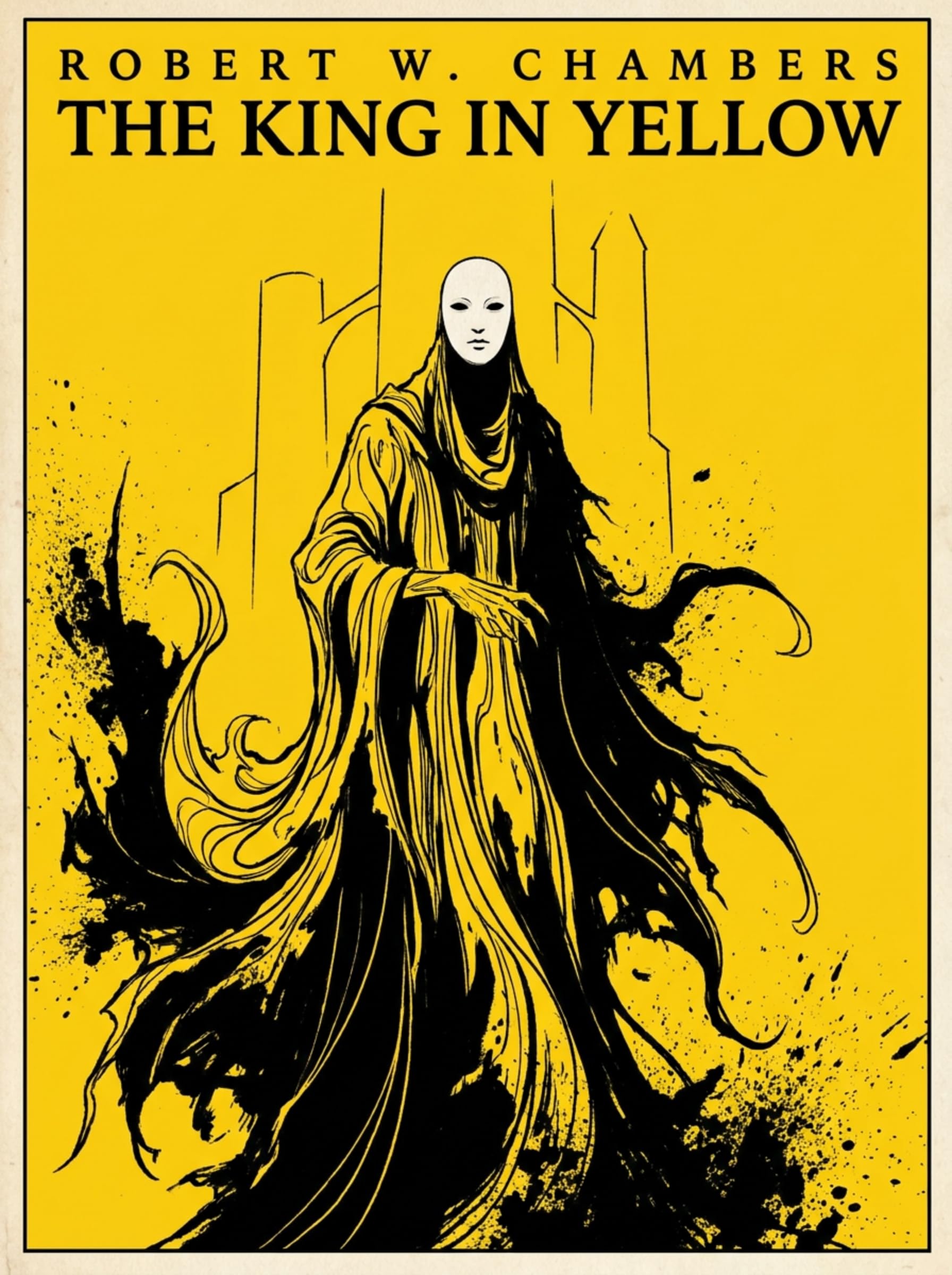
A book that contains another book — a fictional play in two acts whose second act drives every reader insane. The play does not exist. Robert W. Chambers never wrote it. What he wrote instead, in 1895, was one of the most audacious works of horror fiction in the English language. This Erato Press critical edition reads The King in Yellow as the structurally radical and genuinely disturbing book it has always been.
Published at the height of the decadent movement — the same moment that produced Oscar Wilde’s trial and The Yellow Book — Chambers drew on his years as an art student in the Quartier Latin to create something unprecedented in American fiction: a work of cosmic horror whose menace is entirely literary. The King in Yellow is not a monster. It is a text. The names that recur — Carcosa, Hastur, the Lake of Hali, the Pallid Mask — are pure verbal invention, designed to sound as though they belong to a tradition the reader has somehow forgotten. H. P. Lovecraft, reading the book in 1927, recognized at once what Chambers had done; the Necronomicon is essentially Chambers’s invented play transposed into occult treatise.
Hildred Castaigne — the unreliable narrator of a future America, whose delusion anticipates fascist aesthetics by four decades The King in Yellow — the play that cannot be read safely, the absent centre around which ten stories orbit Carcosa — the city that does not exist, whose name became the geography of cosmic dread The Yellow Sign — the story Lovecraft called one of the great weird tales, whose final pages are among the most frightening in nineteenth-century American fiction
✦ The complete text of all ten stories in The King in Yellow (1895), including Cassilda’s Song
This edition also includes: ✦ The Play That Cannot Be Written — a critical essay in nine sections examining the meta-literary structure, the decadent moment, the four horror stories, the genealogy from Bierce through Chambers to Lovecraft to True Detective, and the paradox of a writer who produced one of the most influential weird fiction works and then spent forty years writing popular romances ✦ About Robert W. Chambers (1865–1933) — a biography in five sections
For readers who enjoy: ✦ Cosmic horror from Chambers through Lovecraft to the present ✦ Meta-literary horror — books about books that destroy their readers ✦ Decadent fiction and the culture of the 1890s ✦ The weird fiction tradition from Borges to Ligotti
“The play does not exist. The reader will never read it. And yet, by the time the book is finished, something has happened to them that they cannot quite name.”