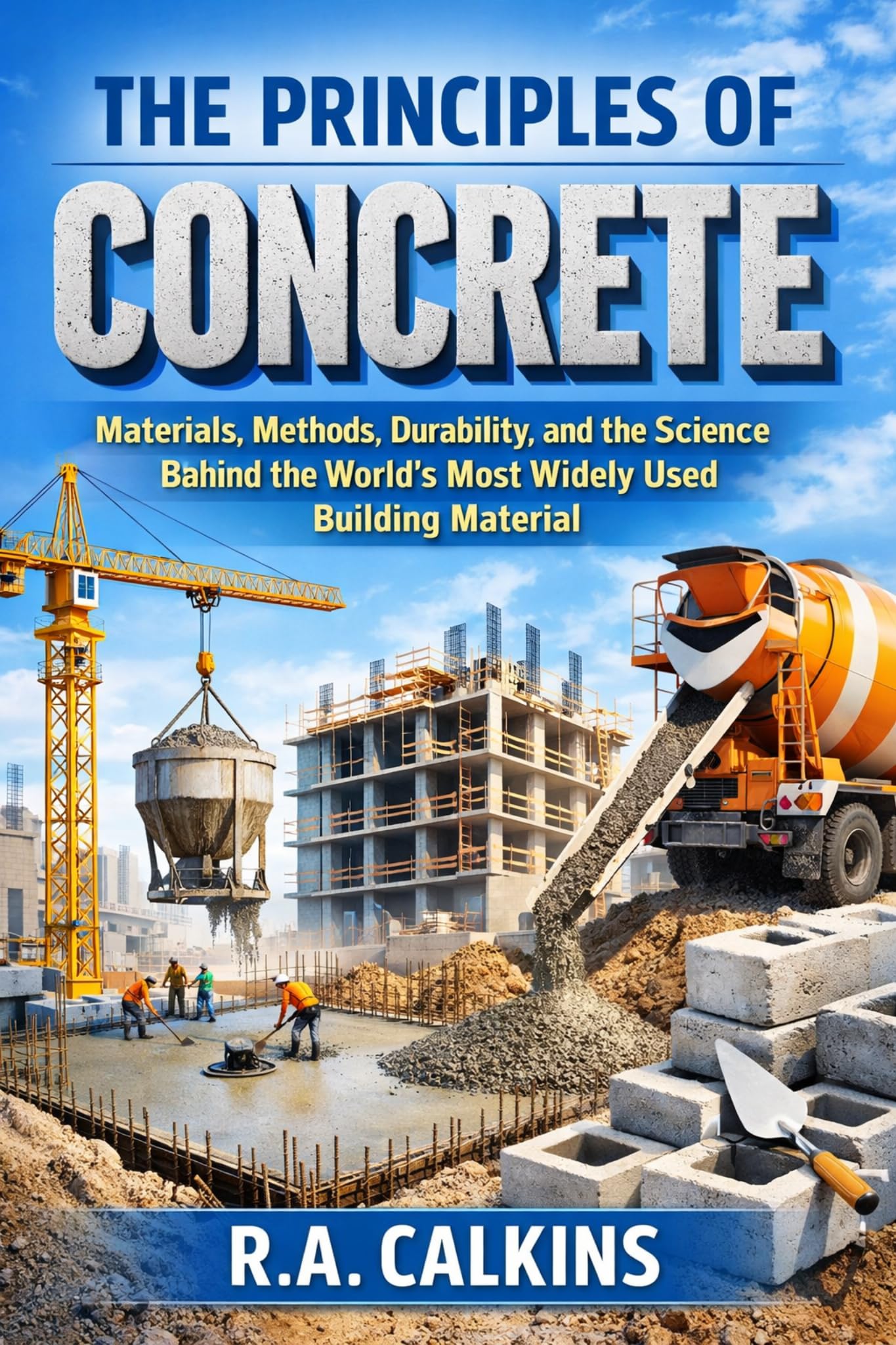
The Principles of Concrete is a clear, substantial guide to one of the most important materials in the built world. Beneath roads, bridges, homes, towers, schools, ports, tunnels, and foundations of nearly every kind, concrete quietly supports modern civilization. Yet for all its familiarity, few people fully understand what it is, how it works, why it lasts, or why it fails. This book opens that world with precision, depth, and practical clarity.
From the basic ingredients of cement, water, sand, and stone to the complex realities of hydration, proportioning, curing, reinforcement, cracking, and durability, this volume explains concrete as both a science and a craft. It shows why concrete cannot be understood as a mere gray mass, but as a carefully balanced system in which every stage matters. The result is a serious, readable treatment of the material that has shaped the modern age. The source text presents concrete as “a composite material whose properties arise from the interaction of its ingredients and the conditions under which it is mixed, placed, and cured” and frames the book as an examination of “materials, methods, durability, and the science behind” it .
Written in a clean, text-centered format, this edition is designed for readers who want direct, concentrated explanation and strong subject matter without distraction. It is ideal for those who prefer a streamlined reading experience focused on the principles themselves.
Inside, you will explore the chemistry of cement, the role of aggregates, the water-cement relationship, mix design, compressive strength, shrinkage, cracking, freeze-thaw exposure, chemical attack, reinforcement behavior, workmanship, curing practice, and the reasons concrete succeeds or deteriorates over time. The book also places modern concrete in its historical and structural context, tracing how this human-made stone became foundational to construction across the world.
This is not a shallow overview. It is a disciplined study for readers who want more than scattered facts or simplified summaries. Builders, engineers, contractors, students, inspectors, owners, and serious readers of construction science will find here a thoughtful and coherent explanation of concrete in both theory and application. The document itself states that the book examines concrete “from the ground up” through its “ingredients, chemistry, mixture proportioning, structural behavior, methods of placement, curing practices, reinforcement systems, common defects, durability concerns, repair strategies, surface treatments, testing methods, and future developments” .
If you want to understand why concrete remains indispensable, why good concrete work demands discipline, and why failure so often begins with small neglected details, The Principles of Concrete offers a strong and exacting answer. This is a book for readers who want to understand the material beneath civilization—and to see it with new respect.